Showing posts with label Answers in Genesis. Show all posts

Mar 21, 2014

What is to become of them?


I wrote yesterday about the rebuttals/counter-rebuttals of Nye and Ham and something Ham touched on but he wouldn't talk about further really troubled me. That something was "those Christians" who don't agree with him. He refused to discuss this issue, even when directly challenged by Bill Nye: "There are Christians that don't accept that the earth could somehow be this extraordinarily young age because of all the evidence around them. And so, what is to be come of them in your view?"

This is what Ham had said to prompt that challenge:
"They, there are a lot of Christians out there that believe in millions of years, but I'd say they have a problem. I'm not saying they're not Christians...because salvation is conditional on faith in Christ not the age of the earth, but there's an inconsistency with what the Bible teaches. If you believe in millions of years, you've got death and bloodshed, suffering and disease over millions of years leading up to man because that's what you see in the fossil record. The Bible makes if very clear; death is a result of man's sin. In fact, the first death was in the garden when God killed an animal, clothed Adam and Eve; the first blood sacrifice pointing toward what would happen through Jesus Christ; one who would die once and for all."
He went on to give examples in the fossil record of carnivores, disease, and thorns. He says that we are told in the Bible that all creatures were vegetarians until after the flood and that disease is not 'good' and thorns were a result of the fall. Since the Bible tells us these things that contradicts the millions of years theory of the age of the earth and they are incompatible.

This issue of death is a real problem that needs to be addressed, but there are problems Ham must face as well. These are problems Nye is pointing out, which Ham is skirting one by one for the most part. He's not answering the questions. It seems to me he has more problems to work through with a young earth than those who do not hold his view. Perhaps he will get into it more in the question and answer period, but I want to know what he thinks will become of those who don't agree with him. Are they refused membership in the church? Are they removed or prevented from being in leadership? Are they allowed to be pastors or professors? Are they excommunicated altogether until they fall in line with his view? What is to become of them? It's a big question and a big problem for Ham and the church of North America in general. Sadly, the story has often been a clarification of doctrinal statement, the cracking of the whip, and the dismissal of pastors and teachers. You can read about one recent example here.

Mar 20, 2014

Nye vs Ham - Rebuttals and Counter Rebuttals


I'm finally getting back to the Nye vs Ham debate.I've already covered preliminaries here and here as well as the opening arguments of Ken Ham and Bill Nye. Today I'm covering their five minute rebuttals and counter rebuttals. Again, you can watch the entire debate on YouTube here. As with other posts, I'll summarize the content and then make some remarks afterward.

Ken Ham
  • Claims we cannot observe the age of the earth because that is historical science
  • The Bible is the only source of historical science
  • The age of the earth is determined by the six days of creation and adding up the genealogies
  • We do observe decay, but when we use it to talk about the past that is a problem
  • There are 3 assumptions with radiometric dating: That we know the starting number of parent atoms, that all daughter atoms come from parent atoms, and that the rate of decay has been constant
  • Some Christians do believe in an old earth and they're still saved because that is through faith in Jesus and not in the age of the earth, but there is a problem because they are not consistent with the Bible.
  • Problems: Death before the fall, carnivores before the flood, brain tumors and thorns in the fossil record before the fall would have been.
  • There is one infallible dating method: the Word of God from someone who was there.
I find it strange that Ham would try to make a claim that we cannot observe the age of the earth and yet when answering the question,"Is creation a viable model of origins in today's modern scientific era?", he answers 'yes'. It seems like his creation model has no room for any modern science based on observation. I suppose this means he reject modern science wholesale, yet in other places he affirms science for other purposes of gaining knowledge. It is an interesting and bold move to deny that we can know the age of something based on observation. I also think he makes similar bold claims about radioactive decay. Essentially he denies constant rates of decay and must assert that God created with the appearance of age (which I think makes God deceptive).

I was glad to hear him include other Christians that don't share his view in some capacity, but am troubled by his assertion that we are not consistent with our treatment of the Bible. That is a pretty bold claim that he left untouched and is well beyond the capability and knowledge of Nye to address in this debate. He did bring up some very legitimate problems that need to be dealt with soon thereafter, such as death before the fall, carnivores, thorns, etc. I'll write a post in the future addressing the death issue in particular.
 
Bill Nye
  • He asks: Are fish sinners? Why do they die?
  • He wonders why Ham keeps asserting that we cannot observe the past. That is all that happens in astronomy and we actually do this all of the time. The speed of light and sound requires that we see and observe things in every day life that have already happened in the past.
  • You cannot separate the natural laws of the present from the past. How are they different?
  • Gives a telephone analogy about the Bible being an unreliable record
  • If we accept the American English bible as interpreted by Ham as more respected than what can be observed in your backyard, that is very troubling.
I found some of Nye's comments naive and condescending such as asking if fish were sinners.The telephone analogy about the transmission and reliability of the Bible is ignorant to that field of study. We have incredibly accurate copies of original documents and the discovery of additional manuscripts in the past century as well as historical background information means that our access to an accurate translation in our own language hasn't been this good since the earlier centuries of the church (in my opinion).

As for his assertions about being able to observe the age of the earth and the past, he makes good points. This distinction of historical science is unique to Ham and claiming that it simply has to be that way is not a scientific claim, it is a faith claim that denies consistency with reality. The separation of the past and present natural law is a huge problem. Not all YEC people do this, but Ham, apparently, does.

Ken Ham
  • We do have constant natural laws and they only fit in a worldview with a Law Giver
  • There are other Phd's in Ham's camp, it's not just Ham
  • God created 'kinds' not species so there were only 1,000 kinds on the ark
  • We didn't see tree layers forming or ice layers forming so we can't use those
  • Starlight gives problems for everyone which is why they have inflation theories, etc.
Most of this section seemed to me as though Ham was simply being evasive. He seems to contract himself from early in affirming that there are natural laws that have been constant. He tags on that natural law is only possible in a worldview where there is a Law Giver, ie: God. I think it would be more accurate to say that this worldview is compatible with consistent natural laws and provides explanatory force philosophically. Saying it is the only worldview where natural law is possible seems a bit off to me.

Saying that there were 1,000 'kinds' on the ark isn't much of a solution to Nye's challenge. Saying we didn't see the tree layers or ice layers forming and so they can't be used is bizarre. Saying that starlight gives problems for everyone is also evasive.

Bill Nye
  • "Thank you Mr. Ham, but I am completely unsatisfied."
  • If there were only 1,000 'kinds' on the ark, there would have to have been 40 new species created every single day since the flood in order for there to be the number of species we now have.
  • The fundamental disagreement is about what you can actually prove.
  • Have all relationships between animals changed only after the flood?
  • What becomes of other religious people who don't accept your view?
  • Ham claims to be a scientist, not a theologian? Nye asks for origins according to science and Ham gives be bible verses. His scientific theory of origins is based on the Old Testament.
  • When scientists find that a model doesn't hold water they throw it away. Provide an explanation that changes the model or theory about the age of the earth, evolution, etc. and you will be applauded and praised for it by scientists.
 It was a spectacularly appropriate opening line, which is why I was sure to quote it accurately. The math about getting to the appropriate number of species from the ark until today is a staggering challenge to the question of the flood, which I'm not dealing with in this series. For now I'll say that there are many Christians who believe in a local flood instead of a global one. I've been agnostic on this issue for awhile and haven't studied it enough to have a firm opinion. The use of the term 'world' and 'earth' is much looser than it sounds to our modern English ears. When we consider that the Hebrew writers had no concept of a 'globe' at all (they thought the world was flat) it becomes easier to conceive of the story as a local flood in their known 'world' or 'earth' (I'm not even sure which Hebrew word it is...I told you I haven't studied enough to have a firm opinion.).

The fundamental disagreement is definitely about what is even possible to be proven scientifically. I do hold to the Bible as the primary authority, but we have to read it on its own terms and not ones we impose upon it. We also have to explain how it is consistent with reality, which YEC peeps need to do better than Ham's evasiveness in this rebuttal period of the debate. I don't think the Bible asserts an age of the earth either young or old. I don't think that is what Genesis is about and Ham's interpretation of these texts are not an adequate engagement to the question of their debate at all. Nye is right to point out what Ham is doing. Ham is doing theology, not science.

Mar 19, 2014

MacArthur ponders whether visits to heaven are for real


I am not a fan of John MacArthur or Answers in Genesis, but I came across this article when a Facebook friend shared it this week and found points of agreement and disagreement that I think are valuable to point out. This is how MacArthur opens the discussion:
In recent years, Christian booksellers have inundated the evangelical world with testimonies from people who say they visited heaven in near-death experiences. Their stories are full of specific details about what heaven is like, who is there, and what is happening in the celestial realm. But when we compare their claims with Scripture, it becomes clear that they are merely figments of the human imagination, not true visions of heaven as it is described in God’s Word.
And why is that? He goes on to say that if you had a true vision of heaven...
You would be preoccupied instead with the majesty and grace of the One whose glory fills the place. Sadly, undiscerning readers abound, and they take these postmodern accounts of heaven altogether seriously. The stratospheric sales figures and far-reaching influence of these books ought to be a matter of serious concern for anyone who truly loves the Word of God.
I agree with his basic point despite his blaming of postmodernism (and other red herrings ad nauseum). What are we to make of these experiences people have when they nearly die (or medically speaking when they do die)? I think that on biblical grounds we can largely dismiss these accounts as not actually referring to the place Christians call heaven, which is where God can be fully beheld in glorious light causing those experiencing these visions to fall down in awe. These near death experiences (NDEs) are highly subjective and often sound more like a temporary and partial loss of vision (a tunnel with a light at the end), experiences similar to a dream, and encounters with known persons or objects. I am personally unconvinced that any NDE reveals details about heaven.

MacArthur goes on to discuss what the Bible says about heaven and ends with this little nugget: "Not one biblical person ever gave any recorded account of his or her postmortem experience in the realm of departed souls." First, I completely agree that the Bible never mentions anything of these sorts of experiences. But second, why do we think anyone goes to heaven when they die based on this truth claim? If the Bible never mentions anyone having any experience of heaven after death then why should we think that anyone goes to heaven when they die in the first place? I think MacArthur is spinning his wheels at this point.

Until recently I also held that people go to heaven when they die, but I now strongly doubt and tentatively reject that concept altogether. The full explanation is long, but the first thing that lead me to make this radical change was that the Bible is even more silent on the subject than I've already asserted above. The fact is that the Bible never once says that anyone goes to heaven when they die. Let me say that again. There is no explicit claim that anyone goes to heaven at the moment of death. I'm sure this fact and my admission comes as a shock to some readers, but I'll do another series of blog posts on this subject at some point soon to break up the series on Creation. The short version is that, along with William Tyndale and Martin Luther, I tentatively hold the minority position of Christian Mortalism, which holds that when people die they are in 'soul sleep' until the resurrection.

Like MacArthur, I do believe in heaven and that the Bible speaks of it as a spiritual reality and the place where God dwells. However, when he wraps up his entry speaking about the glories of heaven, what he really means is that we are to look forward to dying and being in heaven forever, and that the earth is a bad place to be avoided. He says that our citizenship is in heaven, we are strangers on earth, and that the heavenly Jerusalem city is the capital of heaven where we will live forever. The problem I have with this is, it seems to be purely non-physical,  rejects creation, and seems to ignore key pointers as to the direction of what goes where in the final state of all things. For example, we await Jesus from heaven, the heavenly Jerusalem will come down from heaven to the earth, and that paradise (which I think is clearly the new creation) is also fiercely physical and earthly, and in some sense congruent with present experience. I think MacArthur pushes too hard in his rhetoric, clings to a gnostic leaning tradition of escaping earth to a harp-filled golden city on a cloud, and ultimately misses the full redemption of all things in creation. Along with many theologians, I think that the final state involves some sort of merging of heaven and earth into a transformed reality that involves a renewed, physical creation.

Some people refer to a physical place, even a physical earth, when they use the word 'heaven' to denote the final state. If we use the word in this way, then in the end perhaps the NDEs are more like the real 'heaven' than MacArthur is ready to admit.

Mar 13, 2014

Why I'm blogging about the views of Creation.


I've had a few people challenge me on my blogging of late (as well as lot's of encouragement). I very much welcome this and appreciate it. If nothing else, it keeps me questioning my purpose for writing and lets me know someone is reading. After a recent post one reader seemed to get the impression that I was aghast that anyone would hold to a Young Earth Creationist position and implied/concluded that I basically haven't gotten my fingers dirty and tired to understand that viewpoint. I don't think this was a fair read of the post I had written since it was stating that I don't think Genesis 1 requires that we must hold to a literal six 24hr day young earth creationism. Not only that, but I have come away from that viewpoint after holding it as long as I can remember and it took me a long time to do so after a lot of studying (and after spending a lot on books!). Even after I changed my mind on the matter I was still very cautious about who I would would speak to about it. And why was I cautious? What was the reason for not wanting to reveal that I thought the earth was old? Fear. And I'm not alone. Tomorrow's post will address this major problem in the North American church in more depth. For now I'd like to leave you with a summary of why I'm blogging about this subject.

In short, what I am attempting to do is demonstrate the diversity of other Christian perspectives on the issue demonstrating that they are reasonable and take the bible just as seriously as young earth creationists. I want to share some thoughts on the subject and point people to other posts and resources aside from myself. The whole series of posts on an old earth is in response to the debate between Bill Nye and Ken Ham and the media attention it garnered. I am tired of some Creationists like Ham who give the impression that their view is the Christian view and I'm tired of the media perpetuating it. I decided after the debate and it's aftermath to be very public about my view of an old earth so that other Christians who also hold such a view would not feel ostracized, shamed, leave the church, live in fear, etc. I want to help equip others to understand one another and be able to articulate their beliefs well and remain part of the church. I'm looking to make peace and create space for diversity of opinion including those such as Ken Ham.

Mar 4, 2014

The Reliability of Radiometric Dating with Dr. Roger Wiens

I was challenged last week as to why I reject Young Earth Creationism and firmly believe that the earth is old. Well, if you're looking for scientific evidence, this is the post for you. If you're looking for biblical evidence, wait your turn. I'll write about that for tomorrow.

Again, I'll preface this by saying that I'm not a scientist. Like anyone, I rely on the research of others. If you think the earth is young based on what you've been taught or what you read in your Bible you are also dependent on the research of others unless you have discovered an older Hebrew manuscript or translation than was previously uncovered and have the capability of translating it yourself in light of it's time, culture, etc. Whenever I talk about science, I admit that I"m under qualified, but that doesn't mean I can't look at and understand what researchers have uncovered and come to a consensus on.

One such item is radiometric dating. While I've learned about it before, I was recently pointed to a helpful article written by Dr. Roger C. Wiens called "Radiometric Dating: A Christian Perspective." As you may have guessed from the title, he is a Christian. His doctoral thesis was on isotope ratios in meteorites, including surface exposure dating. He prefaces his paper with the following:


     "Radiometric dating--the process of determining the age of rocks from the decay of their radioactive elements--has been in widespread use for over half a century. There are over forty such techniques, each using a different radioactive element or a different way of measuring them. It has become increasingly clear that these radiometric dating techniques agree with each other and as a whole, present a coherent picture in which the Earth was created a very long time ago. Further evidence comes from thecomplete agreement between radiometric dates and other dating methods such as counting tree rings or glacier ice core layers. Many Christians have been led to distrust radiometric dating and are completely unaware of the great number of laboratory measurements that have shown these methods to be consistent. Many are also unaware thatBible-believing Christians are among those actively involved in radiometric dating.

     This paper describes in relatively simple terms how a number of the dating techniques work, how accurately the half-lives of the radioactive elements and the rock dates themselves are known, and how dates are checked with one another. In the process the paper refutes a number of misconceptions prevalent among Christians today. This paper is available on the web via the American Scientific Affiliation and related sites to promote greater understanding and wisdom on this issue, particularly within the Christian community." (bold emphasis mine)

I will write another post at some point about the human genome project, but it is interesting to note that, as with the genome project, Christians are also actively involved with this area of science. It is not 'those naturalistic atheist scientists' trying to disprove anyone's faith or religious text. It is a variety of scientists doing their best to discover the truth about the age of the universe and specifically this planet. A suspicion of conspiracy is simply one type of rhetorical move that is easily set aside. A more subtle one is that YEC peeps will often use dismissive language of carbon dating (specific example) not radiometric dating (broad method). Carbon dating is only one of the over 40 methods of radiometric dating and, according to Dr. Wiens in his introduction, is seldom used in dating the age of rocks. Carbon dating is used primarily for dating organic materials whereas the age of rocks is determined by potassium-argon and uranium-lead dating. Wiens explains the key to how these radiometric clocks work:

Wiens goes on to describe various example of these dating methods and how they work before touching on the age of the earth. By dating the oldest rocks, moon rocks, and asteroids a common pattern emerges in that the 'bodies' in our solar system came to exist about the same time: 4.5-4.6 billion years ago. He then touches on a number of other dating methods that go back 60,000+ years such as tree rings and ice cores. These ice core samples can be counted in multiple ways: visually, by the dust layers, and other annual chemical deposits.

Wiens finishes his article on a more pastoral or apologetic note appealing to Christians to take the data seriously and not be so easily dismissive:

"...some Christians question whether we can believe something so far back in the past. My answer is that it is similar to believing in other things of the past. It only differs in degree. Why do you believe Abraham Lincoln ever lived? Because it would take an extremely elaborate scheme to make up his existence, including forgeries, fake photos, and many other things, and besides, there is no good reason to simply have made him up. Well, the situation is very similar for the dating of rocks, only we have rock records rather than historical records. Consider the following:

  • There are well over forty different radiometric dating methods, and scores of other methods such as tree rings and ice cores.
  • All of the different dating methods agree--they agree a great majority of the time over millions of years of time. Some Christians make it sound like there is a lot of disagreement, but this is not the case. The disagreement in values needed to support the position of young-Earth proponents would require differences in age measured by orders of magnitude (e.g., factors of 10,000, 100,000, a million, or more). The differences actually found in the scientific literature are usually close to the margin of error, usually a few percent, not orders of magnitude!
  • Vast amounts of data overwhelmingly favor an old Earth. Several hundred laboratories around the world are active in radiometric dating. Their results consistently agree with an old Earth. Over a thousand papers on radiometric dating were published in scientifically recognized journals in the last year, and hundreds of thousands of dates have been published in the last 50 years. Essentially all of these strongly favor an old Earth.
  • Radioactive decay rates have been measured for over sixty years now for many of the decay clocks without any observed changes. And it has been close to a hundred years since the uranium-238 decay rate was first determined.
  • Both long-range and short-range dating methods have been successfully verified by dating lavas of historically known ages over a range of several thousand years.
  • The mathematics for determining the ages from the observations is relatively simple."

Lastly, Wiens addresses a common YEC claim made when the data is just so obvious that it can't be denied that things really do appear to look old such as rocks, starlight, etc. They often claim that God created the universe with the appearance of age. They often appeal to Adam as being created a grown man and not an infant. Wiens points out that this is not a scientific claim, but a philosophical or theological one. I agree with him when he follows up by saying that those taking this stance are therefore insisting that God intentionally created in a way that would deceive us. I have a big problem with this, but apparently YEC adherents have no problem with it at all.

Wiens closes his paper with the following:

"As scientists, we deal daily with what God has revealed about Himself through the created universe. The psalmist marveled at how God, Creator of the universe, could care about humans: "When I consider Your heavens, the work of Your fingers, the moon and the stars, which You have set in place, what is man that You are mindful of him, the son of man that You care for him?" (Psalm 8:3-4). Near the beginning of the twenty-first century we can marvel all the more, knowing how vast the universe is, how ancient are the rocks and hills, and how carefully our environment has been designed. Truly God is more awesome than we can imagine"
To that I say, Amen!

Mar 3, 2014

Concordism = making ancient texts teach modern science


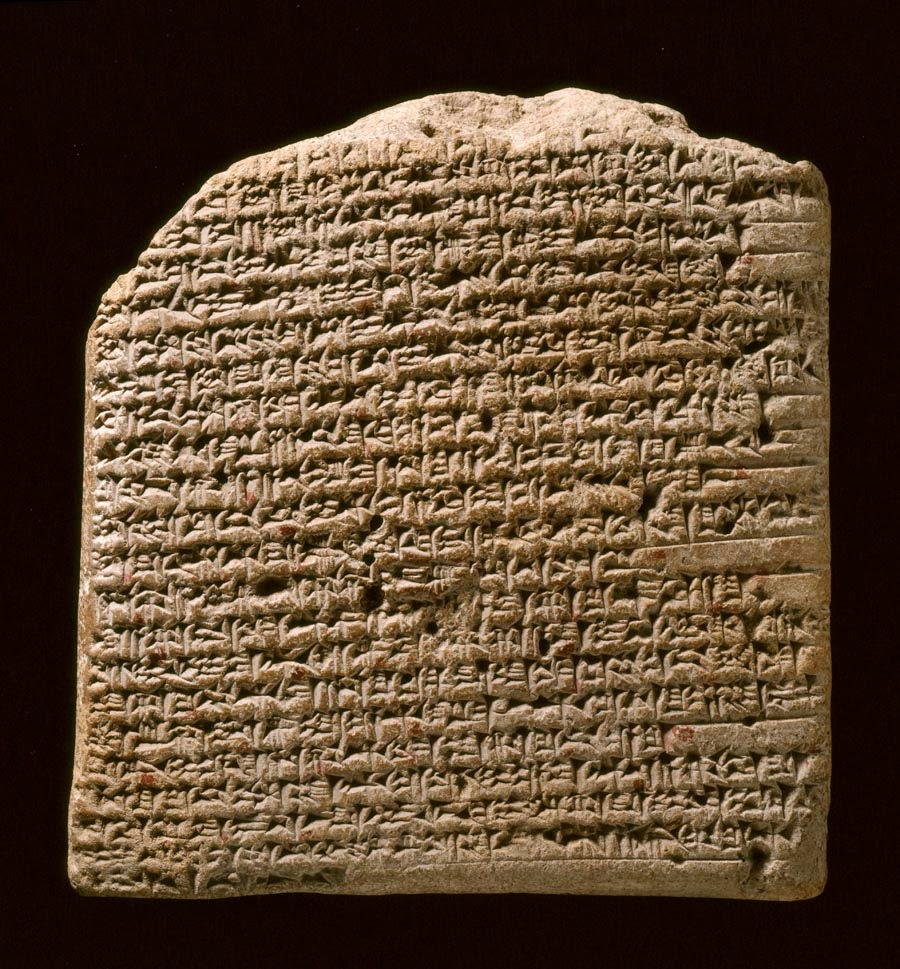
What if I told you this was an ancient version of the modern tablets we have today, like the iPad? You can kinda see it...It's handheld, you can write on it, bring it with you...it's more convenient than writing in the sand. It saves your document...But it's quite a stretch. What if I told you that the original maker of this ancient tablet knew all about modern tablets and their capabilities in the great complexity yet didn't have the precise words or concepts to articulate the vision he had of this amazing device. What if I said that despite the limitations of time, culture, language, and geography the maker embedded the concepts and details to the best of their ability for us to decipher in the future. You say that is ridiculous! I agree. This, in some sense, is concordism in action.

When interpreting the Bible there are several approaches one can take and it is not obvious which one to use. In fact, this is why there are different interpretations of texts by Christians. Depending on the assumptions you have going in you will come out with a different result because you are trying to find a different answer. Most of the time as an interpreter you do your best to put all of your own assumptions aside and let the text speak for itself. However, knowing the context of the writing is required to understand a text as well. It can be a tricky balance. An example is the book of Revelation. Should we take everything literally as dragons and rivers of blood, four horsemen, a woman swallowing the moon, and two beasts with crazy heads and horns, etc? I think not! I see this and know that it is apocalyptic imagery that it is symbolic and trying to communicate a message through a particular medium.

When we come to the early texts of Genesis I feel much the same way, and as with Revelation, I feel I still have much to learn and understand. However, There is a choice we need make that affects our interpretation. Does Genesis teach us science? I hold loosely to a sort of literary framework hypothesis approach to interpreting Genesis 1. I do not think Genesis is teaching us that the earth is young, but I also do not think that Genesis is teaching us that the earth is old! I do not hold to a strict harmonizing of the Genesis account and modern science. There are points where one has to ask questions about these issues theologically, but interpretively I see no assertions in the text itself one way or the other that require a particular position on the age of the earth or universe.

Those who hold that Genesis teaches the age of the earth fall into two categories; Young Earth or Old Earth. Both of these are concordist in their approach. Much of the debate surrounds Young Earth Creationists condemning the compromising old earth peeps and fighting the Naturalists/Atheists to no avail. I am a non-concordist, though I do think the earth and universe are old for scientific reasons. For an article outlining the strengths and weaknesses of both approaches, check out this article from BioLogos.org which includes the diagram shown below:

Concordist Interpretations: Non-concordist Interpretations:
Young Earth Interpretation
Creation occurred about 6,000 years ago, during six 24-hour days, in the order described. A scientific study of the earth should confirm this.
Proclamation Day Interpretation
The days of Genesis 1 took place in God’s throne room, wherein God proclaimed each step of creation. The throne-room days are not related to days or time periods on earth.
Gap Interpretation
Earth was created long ago (Gen 1:1), became “formless and empty” (Gen 1:2), and was restored about 6,000 years ago during six 24-hour days.
Creation Poem Interpretation
The number and ordering of the “days” of Genesis 1 are chosen for poetic and thematic reasons rather than historical reasons.
Day-Age Interpretation
Creation occurred over billions of years. Each “day” of Genesis 1 corresponds to a long epoch. Events occurred in the order given in the text, but stretched out over a longer time period.
Kingdom and Temple Interpretations
As the great King, God gives humans dominion as in a “land grant” covenant. Alternatively, God inaugurates the cosmos as his temple. In both cases, the text is not focused on the physical universe.
Appearance of Age Interpretation
Creation occurred about 6,000 years ago during six 24-hour days, but it was created to look like it had a long history of billions of years.
Ancient Near Eastern Cosmology Interpretation
Genesis 1 matches the physical picture of the world believed in Ancient Near East religions, but presents a dramatically different theological picture, proclaiming one God as creator of all rather than many gods.

Here are some other links of interest:
Report by the Presbyterian Creation Study Committee
Catholic view
Greek Orthodox view

Feb 28, 2014

Early church views on Creation in Genesis


I've said several times this week that there are many interpretations Genesis 1 so this post will direct you to quotes of theologians through the last 2,000 years. I also claimed that Ken Ham and Answers in Genesis think they are the only legitimate interpretation and are the ones aligned with historic Christianity. Here is the heading from their article titled, "Other 'Interpretations' of Genesis"
The purpose of this section is to define some of the interpretive schemes that have arisen since the idea of vast ages became popular in the late 18th and early 19th centuries. Please bear in mind that old-earth theologies were essentially non-existent prior to 1800. This fact alone provides strong evidence that these views are not derived from the Bible. Instead, they are an attempt to accommodate the long ages promoted by uniformitarian science. 
 From the outset, the title questions other approaches as actual interpretations. Then it describes them as 'schemes', claims they arose in the 18th and 19th centuries yet were only 'virtually' non-existent before 1800. Is that a fact? Are these views derived from the Bible? Or are they, as AIG claims, an attempt to accommodate modern science?

No. From the early church fathers onward, there has been a diversity of interpretations. In fact, the doctrine of Creation was not a priority for the early Christians. They were a little busy being slaughtered, fed to lions, and used as nightlights for the emperor. When they had time to talk there were more important issues such as the doctrine of the Trinity and the person of Jesus.

The key, once again, is that the views were diverse as pointed out with multiple quotes by this blogger. While it is true that many early Christians did think the earth was young, most of those held that the earth was 6,000 years old then. That would make the earth at least 8,000 years old today. Modern Young Earth Creationists base their belief of a 6,000 year old earth on the chronology of James Ussher and Dr. John Lightfoot.who wrote in the 17th century, not the early church as often asserted.

For another perspective on the early church's views, here is a 5 part blog post from 'Reasons to Believe'. They use what they call a 'Creation Model' approach to integrating science and the Christian faith.

Feb 27, 2014

Dr. Dr. Dr. Lamoureux and Origins

Here is yet another Christian who holds to an old earth and common ancestry. That title was no error. He holds a doctoral degree in evolutionary biology, evangelical theology, and dentistry. His undergrad was a Bachelor of Science. He also holds a masters in Christian studies and an MDiv.. You can find his bio here.

He is the author of "I love Jesus and I accept evolution"

He has published a paper online called EVOLUTIONARY CREATION: MOVING BEYONDTHE EVOLUTION VERSUS CREATION DEBATE

He has posted free online web lectures on
Beyond the "Evolution" vs. "Creation" Debate 
The Bible & Ancient Science
Intelligent Design: Delusion, Uncertainty, or Divine Revelation?
Was Adam a Real Person?  

He has also posted versions for high school students that are less technical.  
Intelligent Design: Delusion or Divine Revelation?
The Bible & Ancient Science
Beyond the "Evolution" vs. "Creation" Debate

I have not personally viewed all of the contents or necessarily agree on every point, but I think it is very important to circulate alternate Christian views on this subject. As a Christian I feel compelled to counter the sometimes obtuse claims and ridiculous content sometimes presented in perspectives such as Ken Ham and Answers in Genesis.

Feb 26, 2014

John Walton - Origins Today - Genesis Through Ancient Eyes


As promised, here is the link to John Walton's discussion on reading Genesis through Ancient Near Eastern eyes:


Creation in Genesis and the Ancient Near East


This is an artistic depiction by Jonathan Walton of what the Ancient Near Eastern texts of the Bible, including Genesis 1 and others, actually describe. Looks a little different from the earth, doesn't it? Yet this is what the words these texts actually say (but perhaps Young Earth Creationists will claim this would be to read the text too literally).

The first step in reading any text is understanding the context. This includes not only where the passage is in relation to the whole, but the other writings of its day. In this case, other Ancient Near Eastern accounts of origins are significant and illuminating. For example, here is the Egyptian depiction of origins:


The most immediate difference is that there are figures of 'persons' embodying every aspect of creation. The god of the land, sky, etc. The Hebrew account is unique in excluding these personifications or any plurality of deities. There are, of course, other differences, but it is important to also notice the similarities. The same basic form remains with a flat earth, a sky being held up with sun, moon, and stars attached to it with waters above being held back. For a more thorough account of these similarities as well as one of the other Christian interpretations of the Genesis 1 text, read John Walton author of 'The Lost world of Genesis One." I will also post his online presentation in a separate post.


Feb 25, 2014

Bill Nye's opening argument

After Ken Ham delivered his non-evidence based 30 minutes that he somehow thinks justifies his claim that " "Creationism is the only viable model of historical science confirmed by observational science in today's modern scientific era," (which then puts the burden of proof on himself which is a horrible debate move) Bill Nye stepped up. This is a summary of Nye's points
  • Back to the question at hand, does Ham's model actually hold up?
  • Sea shell fossils created the rocks that the very building is built on. Millions of years of layers of ancient life.
  • There is snow ice with 680,000 layers of annual cycles.
  • A tree in sweden is over 9,000 years old. Even in California some are over 6,000 years old. Trees cannot survive under water.
  • You never find a 'lower' water animal mixed with a 'higher' water animal in the fossil record.
  • Points to the multiple types of skulls globally
  • How did all of the animals from Australia come from the ark in the Middle East with no evidence of them anywhere except Australia?
  • The math for Ham's model is preposterous based on a modest assessment of 16 million species today.

  • Several examples of why the ark is problematic: not enough space for 14,008 creatures, wood twisting in water would cause massive leaking, healthy living conditions unattainable, not enough  food, etc.
  • The Amphibious lung fish was predicted to be found in a particular place and it was: Tiktaalik
  • The Ken Ham cannot make predictions and get results.
  • Sexual reproduction in minnow fish combats infection and bacteria better than a-sexual reproduction
  • Prediction of the Big bang 'ecco'. Built a cosmic observatory to hear it and found it as predicted.
  • Elements of rubidium and strontium. Occurs in lava freezing allowing for the dating of fossils.
  • Billions of stars further than 6,000 light years away.
Instead of reaching for red herrings like differing opinions on dog species, bacteria on ecoli, or points not held by the opposition, Nye goes straight for the evidence. He not only gives clearly laid out reasons why he rejects a young earth and support for an old earth, he also goes out of his way to give reasons why there could not have been a global flood. This was not even necessary and yet because he knows it is actually held by Ham he went for it. Ham would have been wise to use this tactic and directed his attention to any evidence he thinks actually supports his view or can hold a candle to Nye's view.

There were a few points that I am well acquainted with which were brought up by Nye such as the distance of the stars, the age of rocks by various dating methods, fossil layers, snow ice layers, tree rings, and the layering of species. For other parts he expanded my per-existing knowledge. I knew most of the arguments against the ark and a global flood, but had not heard about how problematic a wooden ship that large would be for leaking. I knew there were problems with species going global post flood,  but hadn't thought through that there ought to be evidence of their travel not to mention the exponential species growth in such a short amount of time. There were also a lot more types of skulls on his diagram than I recall seeing gathered on a page.

What was most devastating to Ham, however, was the way Nye was able to point out Young Earth Creationism's lack of predictive power. Nye could point to the prediction of the Big Bang echo and that amazing amphibious lung fish fossil swamp in Canada. Perhaps Ham will have some sort of retort that could save some face in the later portion of this debate, but his position of a young earth is currently crushed. However, does Nye think he has done more than he actually has? He ended the debate saying, "Is Ken Ham's creation model viable? I say no! Absolutely not!" Then he pleaded for the listener not to raise scientifically illiterate children who don't understand their place int he cosmos, who don't understand natural law.

My question is whether Bill Nye thinks this is the normative Creation model for Christians or if he is narrowing the debate question as simply Creation according to Ham/AnswersInGenesis. It appears as though it is the latter. Let's hope so. It is clear that Ken Ham is deluded enough to equate his position as the foundation of all Christian faith and seems to think Nye is part of an evil empire of Naturalists. Perhaps Bill Nye will turn out to display more patience and grace out of the two because there was a mere hint of Naturalism in his entire presentation. From what I saw it was all science and no naturalistic attack against faith. In fact, I don't recall him ever denying the possibility that God created through evolution. There was no mention of God, Jesus, etc. There was no need to because Ham took the burden of proof. All Nye had to do was show that the earth was old and that Ham's claim was untenable.

Feb 5, 2014

Nye vs Ham


Last night there was a debate that has sparked far more media attention than I thought it would. This is not a joke. Bill Nye (the science guy) debated Ken Ham (of 'Answers in Genesis') on the following question:
"Is creation a viable model of origins in today's modern scientific era?"
Based on what I have read or seen of their previous work I don't hold to either of their positions and will likely find points of agreement on both sides. I read a few blogs of varying perspectives and opinions about the debate leading up to it, but have not yet watched it. I plan to do so over the next few days and write my thoughts. I will probably do this over several posts as I am aware there are many subjects and issues to address and I will likely have to watch the debate in sections due to its length. Here it is in full: