I was recently asked what I thought the percentage of people was who believed in a young earth. I was just guessing from memory of a survey I had read a few months ago, but thought I should dig up the data and put it up in a blog post. Here is some colorfully arranged data and links to their sources if you care to dig further. Unfortunately, I could only find information on the question of evolution, which, believe it or not, I have barely mentioned haven't discussed yet. The question of whether the earth or universe is old is much more basic and I think there are a lot of people who hold to an old earth even if they believe in a more recent unique creation of human beings in the last 10,000 years. I'll keep digging to find that information and post it if I do. For now, take a look at some fairly recent surveys:
The original chart is here and has some reflections on the data. It is based on a Barna study from 2012.
This one I found here. It is based on the same study.
The one below is not clergy specific:
This one, with more stats, can be found here.
However, this writer doesn't see the issue as divided as it seems and I agree. It is not an either/or. There are a plethora of views and approaches to the subject. Researchers, analysts, theologians, and teachers not only have diverse opinions, but also categorize differently.
Showing posts with label creation. Show all posts
Mar 12, 2014
Mar 11, 2014
What are we to make of Adam & Eve?
)
I was recently asked about my views on Adam and Eve, whether I believe in theistic evolution, etc. While I do plan to cover this issue in the future, we're not quite there yet. However, here is a teaser from Allister McGrath. I will say that I am not concretely in any one camp on the issue of Adam and Eve. Currently I do think of them as historical persons, but in what sense they are historical I am unsure. Based on what McGrath says in this video he may hold a looser view than I do, but I think along similar lines as far as Adam being an archetypal representative of humanity in the same way Jesus was. One can hold to that regardless of their view of Adam's historicity.
Mar 10, 2014
The Structure of Genesis 1
Last week I started writing about the reasons why I think the earth is not young, but actually quite old, and why I think this is not only compatible with the Bible, but also takes it very seriously. Today I want to start looking at the structure of Genesis 1 and what it is actually saying. Much has been written on this subject already so I won't always repeat everything. Today I don't have time to make a chart so I found one instead. It gives a decent picture of something often pointed out, which is the alignment of days 1-3 with days 4-6. Days one and four describe light/darkness vs sun, moon and stars. Days two and five describe sky/water vs birds of the air and fish of the sea. Days three and six describe the appearance of land and it producing vegetation vs the land producing living beings and the creation of humans.
Preparation and population. Forming and filling. Or, as John Walton says, "functions and functionaries." Whatever you call it the pattern is there. I do not see how we must believe in a six successive 24 hour day creation account when this obvious parallelism is present in the text screaming to be noticed. With this parallelism in place it becomes much easier to see that there is a pattern of rhyme and a greater story being told that doesn't require us to think the author meant for light to exist without a source or plants to live without the sun. What I am saying is that a wooden reading of a six 24hr day creation is not the only or the best or reading of the text based on indicators within the text itself..This is not an imposition of modern science or some fanciful theory. It is an attempt to read the text as it is.
The following Chart was take from here.
| Problem | Preparation | Population |
| Verse 2 | Days 1-3 | Days 4-6 |
| darkness | day 1a - creation of light (day) day 1b - separation from darkness (night) |
day 4a - creation of sun day 4b - creation of moon and stars |
| watery abyss | day 2a - creation of firmament (sky) day 2b - separation of waters above from waters below |
day 5a - creation of birds days 5b - creation of fish |
| formless earth | day 3a - separation of earth from sea day 3b - creation of vegetation |
day 6a - creation of land animals day 6b - creation of humanity |
| without form and void | tohu (formlessness) is formed | bohu (the void) is filled |
Here is another chart comparing the Genesis account to one of several Egyptian creation stories. The reasons for noting the similarities with this specific account will be discussed later this week.
Mar 7, 2014
Tim Keller "Evolution, Creation, and Christian Lay-people"
Here is part of an article by Tim Keller written for BioLogos:
In my estimation what current science tells us about evolution presents four main difficulties for
orthodox Protestants. The first is in the area of Biblical authority. To account for evolution we must see at
least Genesis 1 as non-literal. The questions come along these lines: what does that mean for the idea that
the Bible has final authority? If we refuse to take one part of the Bible literally, why take any parts of it
literally? Aren’t we really allowing science to sit in judgment on our understanding of the Bible rather than
vica versa?
The second difficulty is the confusion of biology and philosophy. Many of the strongest proponents
for evolution as a biological process (such as Dawkins) also see it as a ‘Grand Theory of Everything.’ They
look to natural selection to explain not only all human behavior but even to give the only answers to the
great philosophical questions, such as why we exist, what life is about, and why human nature is what it is.
Doesn’t belief in the one idea—that life is the product of evolution—entail the adoption of this whole ‘world
-view’?
The third difficulty is the historicity of Adam and Eve. One way to reconcile what current science says
about evolution is to propose that the account of Adam and Eve is symbolic, not literal, but what does this
do to the New Testament teaching of Romans 5 and 1 Corinthians 15 that our sinfulness comes from our
relationship with Adam? If we don’t believe in an historical fall, how did we become what the Bible says we
are—sinful and condemned?
The fourth difficulty is the problem of violence and evil. One of the greatest barriers to belief in God
is the problem of suffering and evil in the world. Why, people ask, did God create a world in which violence,
pain, and death are endemic? The answer of traditional theology is—he didn’t. He created a good world but
also gave human beings free will, and through their disobedience and ‘Fall’, death and suffering came into
the world. The process of evolution, however, understands violence, predation, and death to be the very
engine of how life develops. If God brings about life through evolution, how do we reconcile that with the
idea of a good God? The problem of evil seems to be worse for the believer in theistic evolution.
Labels:
adam,
Biologos,
Christian,
cosmology,
creation,
Creation debate,
death,
eve,
evolution,
fall of man,
Gen 1,
Genesis,
God,
gospel,
Jesus,
model of origins,
New Testament,
observational science,
old earth,
Tim Keller
Mar 5, 2014
Is creation out of nothing a doctrine 'ex nihilo'?
Today I will continue to cover the reasons why I reject Young Earth Creationism and believe the earth to be quite old. If you're looking for
biblical evidence, reasons, and compatibility you'll find some here. I covered some scientific evidence yesterday including radiometric dating and ice layers.
This is going to have to be a series of posts because there is a lot to cover even off the top of my head so today I will start with the lack of texts that God created the universe out of nothing. I do believe God made the universe out of nothing, but when I examine the Bible there is actually no text that clearly and explicitly states creation 'Ex Nihilo', that is, 'out of nothing'. And before we get too far into this point it is worth saying that the claims of some from the scientific community that the universe indeed did come out of nothing isn't the same thing. For them, 'Nothing' is actually 'Something' such as a quantum vacuum. The move has been deeply criticized for highjacking a term used in philosophy and theology and creating more confusion than light.
Creation 'ex nihilo' is essentially a theological conclusion based upon biblical statements about the nature of God in relation to creation. There are various views on this front: Pantheism, Panentheism, and Theism.
This picture illustrates the differences fairly well. In the middle we see that the universe simply is God, which is pantheism. To the right, we see that the universe is God, but God is still beyond it, or larger than it, or not exhausted by it, which is panentheism. To the left is Theism, which shows that God is completely 'other than' the universe. I think this image does lean more toward a deism, however, because it looks like God is spatially transcendent or beyond the universe with no interaction as though there is a great distance. The Jewish and Christian view of God and creation is one where God is not the universe in any sense, yet sustains it and is immanent, or near, while still transcendent beyond it. The Bible is also clear that God is the only thing or being that is existent from eternity. This is classic theology and because of this view of God and creation it is said that because the universe is in no sense God it must have come into being out of nothing and that such an act was performed by God as the cause.
'But what about Genesis 1?' you ask. This is what it says:
Millard J Erickson agrees with my assessment that the Bible does not explicitly teach this doctrine saying, "Although the language in the Old Testament is not conclusive, the idea of ex nihilo creation can be found in a number of New Testament passages where the aim is not primarily to make a statement about the nature of creation. In particular, there are numerous references to the beginning of the world or the beginning of creation." (Introducting Christian Doctrine 2nd ed. 2001, pg 131). The phrases in the New Testament are pretty much variations of "from the beginning of the world..." or "since the creation of the world..." Such instances are incidental and not actually teaching creation ex nihilo, yet the implication of these types of statements make it reasonable to hold to the doctrine by inference.
This may seem like a major tangent and have nothing to do with whether or not the earth is young, but stay with me. Even conservative theologians agree that there are only implications from texts and that many of the clearer sounding texts aren't teaching about creation. This means that the creation texts themselves, and particularly the oldest ones, are not giving an account of the moment where something came out of nothing. It is possible to believe that these texts are describing this event, but there is nothing in the texts themselves that requires us to interpret the texts in this way. That means that the Bible's account of creation cannot be giving a clear indication of the age of the universe.
This is going to have to be a series of posts because there is a lot to cover even off the top of my head so today I will start with the lack of texts that God created the universe out of nothing. I do believe God made the universe out of nothing, but when I examine the Bible there is actually no text that clearly and explicitly states creation 'Ex Nihilo', that is, 'out of nothing'. And before we get too far into this point it is worth saying that the claims of some from the scientific community that the universe indeed did come out of nothing isn't the same thing. For them, 'Nothing' is actually 'Something' such as a quantum vacuum. The move has been deeply criticized for highjacking a term used in philosophy and theology and creating more confusion than light.
Creation 'ex nihilo' is essentially a theological conclusion based upon biblical statements about the nature of God in relation to creation. There are various views on this front: Pantheism, Panentheism, and Theism.
This picture illustrates the differences fairly well. In the middle we see that the universe simply is God, which is pantheism. To the right, we see that the universe is God, but God is still beyond it, or larger than it, or not exhausted by it, which is panentheism. To the left is Theism, which shows that God is completely 'other than' the universe. I think this image does lean more toward a deism, however, because it looks like God is spatially transcendent or beyond the universe with no interaction as though there is a great distance. The Jewish and Christian view of God and creation is one where God is not the universe in any sense, yet sustains it and is immanent, or near, while still transcendent beyond it. The Bible is also clear that God is the only thing or being that is existent from eternity. This is classic theology and because of this view of God and creation it is said that because the universe is in no sense God it must have come into being out of nothing and that such an act was performed by God as the cause.
'But what about Genesis 1?' you ask. This is what it says:
"In the beginning God created the heavens and the earth. Now the earth was formless and empty, darkness was over the surface of the deep, and the Spirit of God was hovering over the waters." (Gen 1:1-2 NIV)Before the first day where God said let there be light we have an earth without form and deep waters. This is not creation out of nothing. The rest of this creation narrative describes God bringing order out of the chaos of the primordial waters and darkness. If you read through you will notice that there simply is not point in which God creates water. He separates it with a solid dome so that some is held back in the sky for rainfall. He makes dry land appear by gathering the waters together (the land was apparently also already there and was not 'created out of nothing' but made to appear by moving the water). The water was already there and God is controlling it; bringing order. There are similar problems with the other creation texts in the Bible. They simply do not make overt proclamation about the first moment of something from nothing.
Millard J Erickson agrees with my assessment that the Bible does not explicitly teach this doctrine saying, "Although the language in the Old Testament is not conclusive, the idea of ex nihilo creation can be found in a number of New Testament passages where the aim is not primarily to make a statement about the nature of creation. In particular, there are numerous references to the beginning of the world or the beginning of creation." (Introducting Christian Doctrine 2nd ed. 2001, pg 131). The phrases in the New Testament are pretty much variations of "from the beginning of the world..." or "since the creation of the world..." Such instances are incidental and not actually teaching creation ex nihilo, yet the implication of these types of statements make it reasonable to hold to the doctrine by inference.
This may seem like a major tangent and have nothing to do with whether or not the earth is young, but stay with me. Even conservative theologians agree that there are only implications from texts and that many of the clearer sounding texts aren't teaching about creation. This means that the creation texts themselves, and particularly the oldest ones, are not giving an account of the moment where something came out of nothing. It is possible to believe that these texts are describing this event, but there is nothing in the texts themselves that requires us to interpret the texts in this way. That means that the Bible's account of creation cannot be giving a clear indication of the age of the universe.
Mar 4, 2014
The Reliability of Radiometric Dating with Dr. Roger Wiens
I was challenged last week as to why I reject Young Earth Creationism and firmly believe that the earth is old. Well, if you're looking for scientific evidence, this is the post for you. If you're looking for biblical evidence, wait your turn. I'll write about that for tomorrow.
Again, I'll preface this by saying that I'm not a scientist. Like anyone, I rely on the research of others. If you think the earth is young based on what you've been taught or what you read in your Bible you are also dependent on the research of others unless you have discovered an older Hebrew manuscript or translation than was previously uncovered and have the capability of translating it yourself in light of it's time, culture, etc. Whenever I talk about science, I admit that I"m under qualified, but that doesn't mean I can't look at and understand what researchers have uncovered and come to a consensus on.
One such item is radiometric dating. While I've learned about it before, I was recently pointed to a helpful article written by Dr. Roger C. Wiens called "Radiometric Dating: A Christian Perspective." As you may have guessed from the title, he is a Christian. His doctoral thesis was on isotope ratios in meteorites, including surface exposure dating. He prefaces his paper with the following:
I will write another post at some point about the human genome project, but it is interesting to note that, as with the genome project, Christians are also actively involved with this area of science. It is not 'those naturalistic atheist scientists' trying to disprove anyone's faith or religious text. It is a variety of scientists doing their best to discover the truth about the age of the universe and specifically this planet. A suspicion of conspiracy is simply one type of rhetorical move that is easily set aside. A more subtle one is that YEC peeps will often use dismissive language of carbon dating (specific example) not radiometric dating (broad method). Carbon dating is only one of the over 40 methods of radiometric dating and, according to Dr. Wiens in his introduction, is seldom used in dating the age of rocks. Carbon dating is used primarily for dating organic materials whereas the age of rocks is determined by potassium-argon and uranium-lead dating. Wiens explains the key to how these radiometric clocks work:
Wiens goes on to describe various example of these dating methods and how they work before touching on the age of the earth. By dating the oldest rocks, moon rocks, and asteroids a common pattern emerges in that the 'bodies' in our solar system came to exist about the same time: 4.5-4.6 billion years ago. He then touches on a number of other dating methods that go back 60,000+ years such as tree rings and ice cores. These ice core samples can be counted in multiple ways: visually, by the dust layers, and other annual chemical deposits.
Wiens finishes his article on a more pastoral or apologetic note appealing to Christians to take the data seriously and not be so easily dismissive:
Lastly, Wiens addresses a common YEC claim made when the data is just so obvious that it can't be denied that things really do appear to look old such as rocks, starlight, etc. They often claim that God created the universe with the appearance of age. They often appeal to Adam as being created a grown man and not an infant. Wiens points out that this is not a scientific claim, but a philosophical or theological one. I agree with him when he follows up by saying that those taking this stance are therefore insisting that God intentionally created in a way that would deceive us. I have a big problem with this, but apparently YEC adherents have no problem with it at all.
Wiens closes his paper with the following:
Again, I'll preface this by saying that I'm not a scientist. Like anyone, I rely on the research of others. If you think the earth is young based on what you've been taught or what you read in your Bible you are also dependent on the research of others unless you have discovered an older Hebrew manuscript or translation than was previously uncovered and have the capability of translating it yourself in light of it's time, culture, etc. Whenever I talk about science, I admit that I"m under qualified, but that doesn't mean I can't look at and understand what researchers have uncovered and come to a consensus on.
One such item is radiometric dating. While I've learned about it before, I was recently pointed to a helpful article written by Dr. Roger C. Wiens called "Radiometric Dating: A Christian Perspective." As you may have guessed from the title, he is a Christian. His doctoral thesis was on isotope ratios in meteorites, including surface exposure dating. He prefaces his paper with the following:
"Radiometric dating--the process of determining the age of rocks from the decay of their radioactive elements--has been in widespread use for over half a century. There are over forty such techniques, each using a different radioactive element or a different way of measuring them. It has become increasingly clear that these radiometric dating techniques agree with each other and as a whole, present a coherent picture in which the Earth was created a very long time ago. Further evidence comes from thecomplete agreement between radiometric dates and other dating methods such as counting tree rings or glacier ice core layers. Many Christians have been led to distrust radiometric dating and are completely unaware of the great number of laboratory measurements that have shown these methods to be consistent. Many are also unaware thatBible-believing Christians are among those actively involved in radiometric dating.
This paper describes in relatively simple terms how a number of the dating techniques work, how accurately the half-lives of the radioactive elements and the rock dates themselves are known, and how dates are checked with one another. In the process the paper refutes a number of misconceptions prevalent among Christians today. This paper is available on the web via the American Scientific Affiliation and related sites to promote greater understanding and wisdom on this issue, particularly within the Christian community." (bold emphasis mine)
I will write another post at some point about the human genome project, but it is interesting to note that, as with the genome project, Christians are also actively involved with this area of science. It is not 'those naturalistic atheist scientists' trying to disprove anyone's faith or religious text. It is a variety of scientists doing their best to discover the truth about the age of the universe and specifically this planet. A suspicion of conspiracy is simply one type of rhetorical move that is easily set aside. A more subtle one is that YEC peeps will often use dismissive language of carbon dating (specific example) not radiometric dating (broad method). Carbon dating is only one of the over 40 methods of radiometric dating and, according to Dr. Wiens in his introduction, is seldom used in dating the age of rocks. Carbon dating is used primarily for dating organic materials whereas the age of rocks is determined by potassium-argon and uranium-lead dating. Wiens explains the key to how these radiometric clocks work:
Wiens goes on to describe various example of these dating methods and how they work before touching on the age of the earth. By dating the oldest rocks, moon rocks, and asteroids a common pattern emerges in that the 'bodies' in our solar system came to exist about the same time: 4.5-4.6 billion years ago. He then touches on a number of other dating methods that go back 60,000+ years such as tree rings and ice cores. These ice core samples can be counted in multiple ways: visually, by the dust layers, and other annual chemical deposits.
Wiens finishes his article on a more pastoral or apologetic note appealing to Christians to take the data seriously and not be so easily dismissive:
"...some Christians question whether we can believe something so far back in the past. My answer is that it is similar to believing in other things of the past. It only differs in degree. Why do you believe Abraham Lincoln ever lived? Because it would take an extremely elaborate scheme to make up his existence, including forgeries, fake photos, and many other things, and besides, there is no good reason to simply have made him up. Well, the situation is very similar for the dating of rocks, only we have rock records rather than historical records. Consider the following:
- There are well over forty different radiometric dating methods, and scores of other methods such as tree rings and ice cores.
- All of the different dating methods agree--they agree a great majority of the time over millions of years of time. Some Christians make it sound like there is a lot of disagreement, but this is not the case. The disagreement in values needed to support the position of young-Earth proponents would require differences in age measured by orders of magnitude (e.g., factors of 10,000, 100,000, a million, or more). The differences actually found in the scientific literature are usually close to the margin of error, usually a few percent, not orders of magnitude!
- Vast amounts of data overwhelmingly favor an old Earth. Several hundred laboratories around the world are active in radiometric dating. Their results consistently agree with an old Earth. Over a thousand papers on radiometric dating were published in scientifically recognized journals in the last year, and hundreds of thousands of dates have been published in the last 50 years. Essentially all of these strongly favor an old Earth.
- Radioactive decay rates have been measured for over sixty years now for many of the decay clocks without any observed changes. And it has been close to a hundred years since the uranium-238 decay rate was first determined.
- Both long-range and short-range dating methods have been successfully verified by dating lavas of historically known ages over a range of several thousand years.
- The mathematics for determining the ages from the observations is relatively simple."
Lastly, Wiens addresses a common YEC claim made when the data is just so obvious that it can't be denied that things really do appear to look old such as rocks, starlight, etc. They often claim that God created the universe with the appearance of age. They often appeal to Adam as being created a grown man and not an infant. Wiens points out that this is not a scientific claim, but a philosophical or theological one. I agree with him when he follows up by saying that those taking this stance are therefore insisting that God intentionally created in a way that would deceive us. I have a big problem with this, but apparently YEC adherents have no problem with it at all.
Wiens closes his paper with the following:
"As scientists, we deal daily with what God has revealed about Himself through the created universe. The psalmist marveled at how God, Creator of the universe, could care about humans: "When I consider Your heavens, the work of Your fingers, the moon and the stars, which You have set in place, what is man that You are mindful of him, the son of man that You care for him?" (Psalm 8:3-4). Near the beginning of the twenty-first century we can marvel all the more, knowing how vast the universe is, how ancient are the rocks and hills, and how carefully our environment has been designed. Truly God is more awesome than we can imagine"To that I say, Amen!
Mar 3, 2014
Concordism = making ancient texts teach modern science
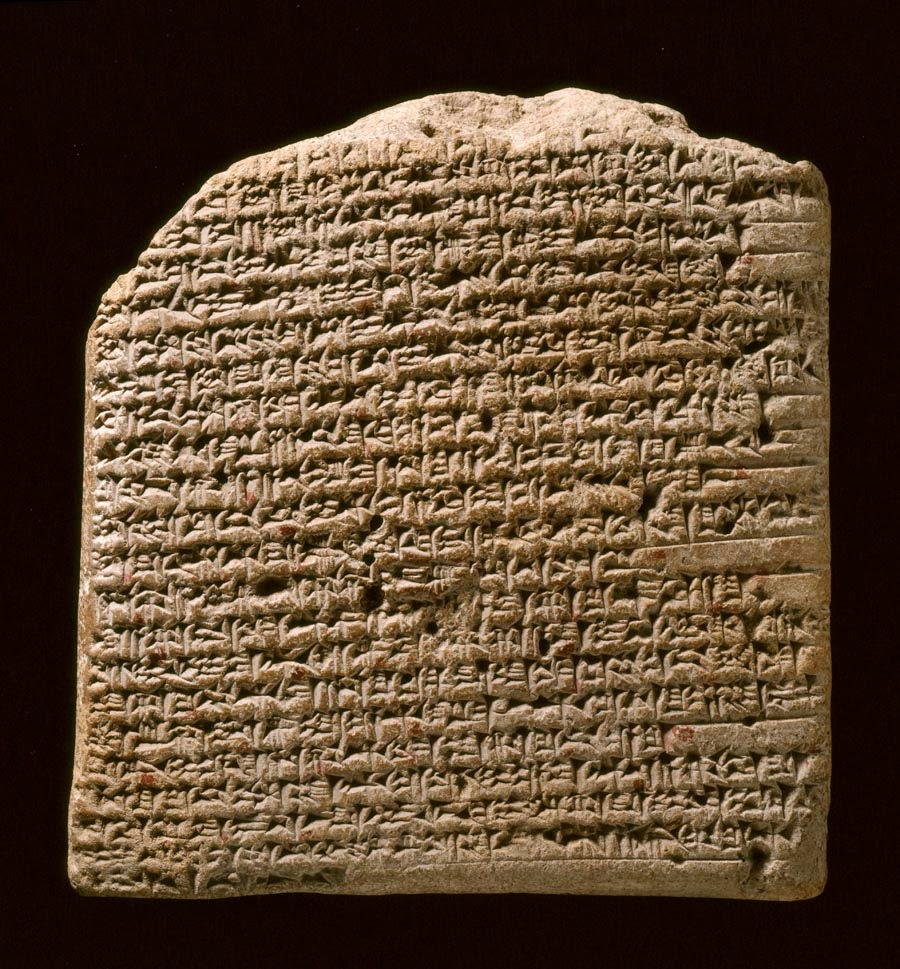
What if I told you this was an ancient version of the modern tablets we have today, like the iPad? You can kinda see it...It's handheld, you can write on it, bring it with you...it's more convenient than writing in the sand. It saves your document...But it's quite a stretch. What if I told you that the original maker of this ancient tablet knew all about modern tablets and their capabilities in the great complexity yet didn't have the precise words or concepts to articulate the vision he had of this amazing device. What if I said that despite the limitations of time, culture, language, and geography the maker embedded the concepts and details to the best of their ability for us to decipher in the future. You say that is ridiculous! I agree. This, in some sense, is concordism in action.
When interpreting the Bible there are several approaches one can take and it is not obvious which one to use. In fact, this is why there are different interpretations of texts by Christians. Depending on the assumptions you have going in you will come out with a different result because you are trying to find a different answer. Most of the time as an interpreter you do your best to put all of your own assumptions aside and let the text speak for itself. However, knowing the context of the writing is required to understand a text as well. It can be a tricky balance. An example is the book of Revelation. Should we take everything literally as dragons and rivers of blood, four horsemen, a woman swallowing the moon, and two beasts with crazy heads and horns, etc? I think not! I see this and know that it is apocalyptic imagery that it is symbolic and trying to communicate a message through a particular medium.
When we come to the early texts of Genesis I feel much the same way, and as with Revelation, I feel I still have much to learn and understand. However, There is a choice we need make that affects our interpretation. Does Genesis teach us science? I hold loosely to a sort of literary framework hypothesis approach to interpreting Genesis 1. I do not think Genesis is teaching us that the earth is young, but I also do not think that Genesis is teaching us that the earth is old! I do not hold to a strict harmonizing of the Genesis account and modern science. There are points where one has to ask questions about these issues theologically, but interpretively I see no assertions in the text itself one way or the other that require a particular position on the age of the earth or universe.
Those who hold that Genesis teaches the age of the earth fall into two categories; Young Earth or Old Earth. Both of these are concordist in their approach. Much of the debate surrounds Young Earth Creationists condemning the compromising old earth peeps and fighting the Naturalists/Atheists to no avail. I am a non-concordist, though I do think the earth and universe are old for scientific reasons. For an article outlining the strengths and weaknesses of both approaches, check out this article from BioLogos.org which includes the diagram shown below:
| Concordist Interpretations: | Non-concordist Interpretations: |
|---|---|
| Young Earth Interpretation Creation occurred about 6,000 years ago, during six 24-hour days, in the order described. A scientific study of the earth should confirm this. |
Proclamation Day Interpretation The days of Genesis 1 took place in God’s throne room, wherein God proclaimed each step of creation. The throne-room days are not related to days or time periods on earth. |
| Gap Interpretation Earth was created long ago (Gen 1:1), became “formless and empty” (Gen 1:2), and was restored about 6,000 years ago during six 24-hour days. |
Creation Poem Interpretation The number and ordering of the “days” of Genesis 1 are chosen for poetic and thematic reasons rather than historical reasons. |
| Day-Age Interpretation Creation occurred over billions of years. Each “day” of Genesis 1 corresponds to a long epoch. Events occurred in the order given in the text, but stretched out over a longer time period. |
Kingdom and Temple Interpretations As the great King, God gives humans dominion as in a “land grant” covenant. Alternatively, God inaugurates the cosmos as his temple. In both cases, the text is not focused on the physical universe. |
| Appearance of Age Interpretation Creation occurred about 6,000 years ago during six 24-hour days, but it was created to look like it had a long history of billions of years. |
Ancient Near Eastern Cosmology Interpretation Genesis 1 matches the physical picture of the world believed in Ancient Near East religions, but presents a dramatically different theological picture, proclaiming one God as creator of all rather than many gods. |
Here are some other links of interest:
Report by the Presbyterian Creation Study Committee
Catholic view
Greek Orthodox view
Feb 28, 2014
Early church views on Creation in Genesis
I've said several times this week that there are many interpretations Genesis 1 so this post will direct you to quotes of theologians through the last 2,000 years. I also claimed that Ken Ham and Answers in Genesis think they are the only legitimate interpretation and are the ones aligned with historic Christianity. Here is the heading from their article titled, "Other 'Interpretations' of Genesis"
The purpose of this section is to define some of the interpretive schemes that have arisen since the idea of vast ages became popular in the late 18th and early 19th centuries. Please bear in mind that old-earth theologies were essentially non-existent prior to 1800. This fact alone provides strong evidence that these views are not derived from the Bible. Instead, they are an attempt to accommodate the long ages promoted by uniformitarian science.From the outset, the title questions other approaches as actual interpretations. Then it describes them as 'schemes', claims they arose in the 18th and 19th centuries yet were only 'virtually' non-existent before 1800. Is that a fact? Are these views derived from the Bible? Or are they, as AIG claims, an attempt to accommodate modern science?
No. From the early church fathers onward, there has been a diversity of interpretations. In fact, the doctrine of Creation was not a priority for the early Christians. They were a little busy being slaughtered, fed to lions, and used as nightlights for the emperor. When they had time to talk there were more important issues such as the doctrine of the Trinity and the person of Jesus.
The key, once again, is that the views were diverse as pointed out with multiple quotes by this blogger. While it is true that many early Christians did think the earth was young, most of those held that the earth was 6,000 years old then. That would make the earth at least 8,000 years old today. Modern Young Earth Creationists base their belief of a 6,000 year old earth on the chronology of James Ussher and Dr. John Lightfoot.who wrote in the 17th century, not the early church as often asserted.
For another perspective on the early church's views, here is a 5 part blog post from 'Reasons to Believe'. They use what they call a 'Creation Model' approach to integrating science and the Christian faith.
Feb 26, 2014
John Walton - Origins Today - Genesis Through Ancient Eyes
As promised, here is the link to John Walton's discussion on reading Genesis through Ancient Near Eastern eyes:
Creation in Genesis and the Ancient Near East
This is an artistic depiction by Jonathan Walton of what the Ancient Near Eastern texts of the Bible, including Genesis 1 and others, actually describe. Looks a little different from the earth, doesn't it? Yet this is what the words these texts actually say (but perhaps Young Earth Creationists will claim this would be to read the text too literally).
The first step in reading any text is understanding the context. This includes not only where the passage is in relation to the whole, but the other writings of its day. In this case, other Ancient Near Eastern accounts of origins are significant and illuminating. For example, here is the Egyptian depiction of origins:
The most immediate difference is that there are figures of 'persons' embodying every aspect of creation. The god of the land, sky, etc. The Hebrew account is unique in excluding these personifications or any plurality of deities. There are, of course, other differences, but it is important to also notice the similarities. The same basic form remains with a flat earth, a sky being held up with sun, moon, and stars attached to it with waters above being held back. For a more thorough account of these similarities as well as one of the other Christian interpretations of the Genesis 1 text, read John Walton author of 'The Lost world of Genesis One." I will also post his online presentation in a separate post.
Feb 7, 2014
Opening statements of Nye vs Ham
In my opinion this debate stalled before it even began.
I've been trying to figure out what the question the debate was addressing is actually getting at:
"Is creation a viable model of origins in today's modern scientific era?"
I was wondering if it was trying to address the question of "why" or the question of "how". A friend of mine says it is asking "if". The confusion of this vague phrasing probably won't even get addressed well based on the opening statements of the two men.
Ham started by quoting the many scientists who protested the very occasion if this debate. (I don't recall him explaining that it was because it gives the appearance of validating Ham and the museum). Be then gives examples if creationists who are scientists. And says that it is important to define the terms "creation" "evolution" and "science". He brushed past the creation and evolution terms as basically meaning "God's special creation" and "existence due to naturalistic causes". Nye never disputed these in his opening statement. Ham then defines science broadly and attempts to separate "observational science"(what is repeatable" from "historical science" (events that happened in the past). Finally he pushes his view that this debate is really about 2 philosophical worldviews; 2 accounts of origins; 2 beliefs. He asserts that creationism is the only viable model of historical science confirmed by observational science in today's modern scientific era.
Nye opened by saying what we have are 2 stories to which we must ask: "is it viable?" "Does it hold up?" He sees no distinction between observational science and historical science claiming that this distinction is unique to Ham and others in North America. He points to the multitude of religious communities worldwide (which includes Christians) who do not embrace a young earth view of origins. His concern is that creationism stunts America's scientific innovation, discovery, and progress.
I had commented previously on an aquaintence's Facebook post that if we say the debate was about anything other than the answer to the debate question then we are missing the point of the debate. I stand corrected in a sense because so far neither seem to be focused on addressing the question. Nye seems to at least be closer than Ham because he is asking modern scientific questions, but seems to be ignorant of what faith communities are and what they actually believe about evolution, which is different than both Ham and himself. We'll see how the debate progresses from here, but to me this debate is a sham. It is not specific enough in its question or definitions from the outset which could have brought clarity and direction to the interactions rather than quibbling over basic terms of the question. In fact, there should have been a statement for one or the other to defend. I suppose this was set up I become a spectacle from teh beginning. Publicity and some level of credibility for Ham and answers in genesis and a chance for Nye to make them look silly to everyone else. Based on the aftermath both were accomplished.
Labels:
Bill Nye,
creation,
debate,
evolution,
ham,
ham vs nye,
Ken Ham,
nye,
nye vs ham,
science
Subscribe to:
Posts (Atom)