Showing posts with label Creation debate. Show all posts

Mar 20, 2014

Nye vs Ham - Rebuttals and Counter Rebuttals


I'm finally getting back to the Nye vs Ham debate.I've already covered preliminaries here and here as well as the opening arguments of Ken Ham and Bill Nye. Today I'm covering their five minute rebuttals and counter rebuttals. Again, you can watch the entire debate on YouTube here. As with other posts, I'll summarize the content and then make some remarks afterward.

Ken Ham
  • Claims we cannot observe the age of the earth because that is historical science
  • The Bible is the only source of historical science
  • The age of the earth is determined by the six days of creation and adding up the genealogies
  • We do observe decay, but when we use it to talk about the past that is a problem
  • There are 3 assumptions with radiometric dating: That we know the starting number of parent atoms, that all daughter atoms come from parent atoms, and that the rate of decay has been constant
  • Some Christians do believe in an old earth and they're still saved because that is through faith in Jesus and not in the age of the earth, but there is a problem because they are not consistent with the Bible.
  • Problems: Death before the fall, carnivores before the flood, brain tumors and thorns in the fossil record before the fall would have been.
  • There is one infallible dating method: the Word of God from someone who was there.
I find it strange that Ham would try to make a claim that we cannot observe the age of the earth and yet when answering the question,"Is creation a viable model of origins in today's modern scientific era?", he answers 'yes'. It seems like his creation model has no room for any modern science based on observation. I suppose this means he reject modern science wholesale, yet in other places he affirms science for other purposes of gaining knowledge. It is an interesting and bold move to deny that we can know the age of something based on observation. I also think he makes similar bold claims about radioactive decay. Essentially he denies constant rates of decay and must assert that God created with the appearance of age (which I think makes God deceptive).

I was glad to hear him include other Christians that don't share his view in some capacity, but am troubled by his assertion that we are not consistent with our treatment of the Bible. That is a pretty bold claim that he left untouched and is well beyond the capability and knowledge of Nye to address in this debate. He did bring up some very legitimate problems that need to be dealt with soon thereafter, such as death before the fall, carnivores, thorns, etc. I'll write a post in the future addressing the death issue in particular.
 
Bill Nye
  • He asks: Are fish sinners? Why do they die?
  • He wonders why Ham keeps asserting that we cannot observe the past. That is all that happens in astronomy and we actually do this all of the time. The speed of light and sound requires that we see and observe things in every day life that have already happened in the past.
  • You cannot separate the natural laws of the present from the past. How are they different?
  • Gives a telephone analogy about the Bible being an unreliable record
  • If we accept the American English bible as interpreted by Ham as more respected than what can be observed in your backyard, that is very troubling.
I found some of Nye's comments naive and condescending such as asking if fish were sinners.The telephone analogy about the transmission and reliability of the Bible is ignorant to that field of study. We have incredibly accurate copies of original documents and the discovery of additional manuscripts in the past century as well as historical background information means that our access to an accurate translation in our own language hasn't been this good since the earlier centuries of the church (in my opinion).

As for his assertions about being able to observe the age of the earth and the past, he makes good points. This distinction of historical science is unique to Ham and claiming that it simply has to be that way is not a scientific claim, it is a faith claim that denies consistency with reality. The separation of the past and present natural law is a huge problem. Not all YEC people do this, but Ham, apparently, does.

Ken Ham
  • We do have constant natural laws and they only fit in a worldview with a Law Giver
  • There are other Phd's in Ham's camp, it's not just Ham
  • God created 'kinds' not species so there were only 1,000 kinds on the ark
  • We didn't see tree layers forming or ice layers forming so we can't use those
  • Starlight gives problems for everyone which is why they have inflation theories, etc.
Most of this section seemed to me as though Ham was simply being evasive. He seems to contract himself from early in affirming that there are natural laws that have been constant. He tags on that natural law is only possible in a worldview where there is a Law Giver, ie: God. I think it would be more accurate to say that this worldview is compatible with consistent natural laws and provides explanatory force philosophically. Saying it is the only worldview where natural law is possible seems a bit off to me.

Saying that there were 1,000 'kinds' on the ark isn't much of a solution to Nye's challenge. Saying we didn't see the tree layers or ice layers forming and so they can't be used is bizarre. Saying that starlight gives problems for everyone is also evasive.

Bill Nye
  • "Thank you Mr. Ham, but I am completely unsatisfied."
  • If there were only 1,000 'kinds' on the ark, there would have to have been 40 new species created every single day since the flood in order for there to be the number of species we now have.
  • The fundamental disagreement is about what you can actually prove.
  • Have all relationships between animals changed only after the flood?
  • What becomes of other religious people who don't accept your view?
  • Ham claims to be a scientist, not a theologian? Nye asks for origins according to science and Ham gives be bible verses. His scientific theory of origins is based on the Old Testament.
  • When scientists find that a model doesn't hold water they throw it away. Provide an explanation that changes the model or theory about the age of the earth, evolution, etc. and you will be applauded and praised for it by scientists.
 It was a spectacularly appropriate opening line, which is why I was sure to quote it accurately. The math about getting to the appropriate number of species from the ark until today is a staggering challenge to the question of the flood, which I'm not dealing with in this series. For now I'll say that there are many Christians who believe in a local flood instead of a global one. I've been agnostic on this issue for awhile and haven't studied it enough to have a firm opinion. The use of the term 'world' and 'earth' is much looser than it sounds to our modern English ears. When we consider that the Hebrew writers had no concept of a 'globe' at all (they thought the world was flat) it becomes easier to conceive of the story as a local flood in their known 'world' or 'earth' (I'm not even sure which Hebrew word it is...I told you I haven't studied enough to have a firm opinion.).

The fundamental disagreement is definitely about what is even possible to be proven scientifically. I do hold to the Bible as the primary authority, but we have to read it on its own terms and not ones we impose upon it. We also have to explain how it is consistent with reality, which YEC peeps need to do better than Ham's evasiveness in this rebuttal period of the debate. I don't think the Bible asserts an age of the earth either young or old. I don't think that is what Genesis is about and Ham's interpretation of these texts are not an adequate engagement to the question of their debate at all. Nye is right to point out what Ham is doing. Ham is doing theology, not science.

Mar 13, 2014

Why I'm blogging about the views of Creation.


I've had a few people challenge me on my blogging of late (as well as lot's of encouragement). I very much welcome this and appreciate it. If nothing else, it keeps me questioning my purpose for writing and lets me know someone is reading. After a recent post one reader seemed to get the impression that I was aghast that anyone would hold to a Young Earth Creationist position and implied/concluded that I basically haven't gotten my fingers dirty and tired to understand that viewpoint. I don't think this was a fair read of the post I had written since it was stating that I don't think Genesis 1 requires that we must hold to a literal six 24hr day young earth creationism. Not only that, but I have come away from that viewpoint after holding it as long as I can remember and it took me a long time to do so after a lot of studying (and after spending a lot on books!). Even after I changed my mind on the matter I was still very cautious about who I would would speak to about it. And why was I cautious? What was the reason for not wanting to reveal that I thought the earth was old? Fear. And I'm not alone. Tomorrow's post will address this major problem in the North American church in more depth. For now I'd like to leave you with a summary of why I'm blogging about this subject.

In short, what I am attempting to do is demonstrate the diversity of other Christian perspectives on the issue demonstrating that they are reasonable and take the bible just as seriously as young earth creationists. I want to share some thoughts on the subject and point people to other posts and resources aside from myself. The whole series of posts on an old earth is in response to the debate between Bill Nye and Ken Ham and the media attention it garnered. I am tired of some Creationists like Ham who give the impression that their view is the Christian view and I'm tired of the media perpetuating it. I decided after the debate and it's aftermath to be very public about my view of an old earth so that other Christians who also hold such a view would not feel ostracized, shamed, leave the church, live in fear, etc. I want to help equip others to understand one another and be able to articulate their beliefs well and remain part of the church. I'm looking to make peace and create space for diversity of opinion including those such as Ken Ham.

Mar 12, 2014

Who holds what view on creation?

I was recently asked what I thought the percentage of people was who believed in a young earth. I was just guessing from memory of a survey I had read a few months ago, but thought I should dig up the data and put it up in a blog post. Here is some colorfully arranged data and links to their sources if you care to dig further. Unfortunately, I could only find information on the question of evolution, which, believe it or not, I have barely mentioned haven't discussed yet. The question of whether the earth or universe is old is much more basic and I think there are a lot of people who hold to an old earth even if they believe in a more recent unique creation of human beings in the last 10,000 years. I'll keep digging to find that information and post it if I do. For now, take a look at some fairly recent surveys:

The original chart is here and has some reflections on the data. It is based on a Barna study from 2012.

This one I found here. It is based on the same study.

The one below is not clergy specific:

This one, with more stats, can be found here.
However, this writer doesn't see the issue as divided as it seems and I agree. It is not an either/or. There are a plethora of views and approaches to the subject. Researchers, analysts, theologians, and teachers not only have diverse opinions, but also categorize differently.


Mar 10, 2014

The Structure of Genesis 1


Last week I started writing about the reasons why I think the earth is not young, but actually quite old, and why I think this is not only compatible with the Bible, but also takes it very seriously. Today I want to start looking at the structure of Genesis 1 and what it is actually saying. Much has been written on this subject already so I won't always repeat everything. Today I don't have time to make a chart so I found one instead. It gives a decent picture of something often pointed out, which is the alignment of days 1-3 with days 4-6. Days one and four describe light/darkness vs sun, moon and stars. Days two and five describe sky/water vs birds of the air and fish of the sea. Days three and six describe the appearance of land and it producing vegetation vs the land producing living beings and the creation of humans.

Preparation and population. Forming and filling. Or, as John Walton says, "functions and functionaries." Whatever you call it the pattern is there. I do not see how we must believe in a six successive 24 hour day creation account when this obvious parallelism is present in the text screaming to be noticed. With this parallelism in place it becomes much easier to see that there is a pattern of rhyme and a greater story being told that doesn't require us to think the author meant for light to exist without a source or plants to live without the sun. What I am saying is that a wooden reading of a six 24hr day creation is not the only or the best or reading of the text based on indicators within the text itself..This is not an imposition of modern science or some fanciful theory.  It is an attempt to read the text as it is.

 The following Chart was take from here.

Problem Preparation Population
Verse 2 Days 1-3 Days 4-6
darkness day 1a - creation of light (day)
day 1b - separation from darkness (night)
day 4a - creation of sun
day 4b - creation of moon and stars
watery abyss day 2a - creation of firmament (sky)
day 2b - separation of waters above from waters below
day 5a - creation of birds
days 5b - creation of fish
formless earth day 3a - separation of earth from sea
day 3b - creation of vegetation
day 6a - creation of land animals
day 6b - creation of humanity
without form and void tohu (formlessness) is formed bohu (the void) is filled

 Here is another chart comparing the Genesis account to one of several Egyptian creation stories. The reasons for noting the similarities with this specific account will be discussed later this week.

Mar 8, 2014

Blog Merger


In August, 2011, I started a blog on the gospel and wrote many articles, pointed to resources, etc.I wrote a fair amount on it in phases, but I didn't have the drive to only write about one subject forever. This year I decided to start writing more again because I if I want to be a writer I have to actually write (duh!). When I went to start another blog I made the choice to simply relaunch one that I had started year ago under my own name. I deleted all previous posts and started over with the freedom to then write and post on whatever subject I wanted.

On Thursday, I looked at my old blog and decided it was best to merge it to this one because it is much easier to have everything in one place and I wanted to expose my previous work to new readers. I may write a few posts on the gospel in the next few weeks among other things to break up the onslaught of posts on the age of the earth, Genesis, etc. I do have a variety of interests so you can expect more hockey as the playoffs get closer and the same goes for Doctor who...maybe even Survivor even though the last three times I brought it up the person I was speaking said the exact same thing: "Is that show still even on?" sigh...yes people...yes it is. It's the only reality show I have any interest in, it was just renewed for two more seasons and it will not die because it's Survivor....although I did watch Mantracker cause that's Canadian and awesome.

Mar 7, 2014

Tim Keller "Evolution, Creation, and Christian Lay-people"

Here is part of an article by Tim Keller written for BioLogos:

In my estimation what current science tells us about evolution presents four main difficulties for
orthodox Protestants. The first is in the area of Biblical authority. To account for evolution we must see at
least Genesis 1 as non-literal. The questions come along these lines: what does that mean for the idea that
the Bible has final authority? If we refuse to take one part of the Bible literally, why take any parts of it
literally? Aren’t we really allowing science to sit in judgment on our understanding of the Bible rather than
vica versa?
The second difficulty is the confusion of biology and philosophy. Many of the strongest proponents
for evolution as a biological process (such as Dawkins) also see it as a ‘Grand Theory of Everything.’ They
look to natural selection to explain not only all human behavior but even to give the only answers to the
great philosophical questions, such as why we exist, what life is about, and why human nature is what it is.
Doesn’t belief in the one idea—that life is the product of evolution—entail the adoption of this whole ‘world
-view’?
The third difficulty is the historicity of Adam and Eve. One way to reconcile what current science says
about evolution is to propose that the account of Adam and Eve is symbolic, not literal, but what does this
do to the New Testament teaching of Romans 5 and 1 Corinthians 15 that our sinfulness comes from our
relationship with Adam? If we don’t believe in an historical fall, how did we become what the Bible says we
are—sinful and condemned?
The fourth difficulty is the problem of violence and evil. One of the greatest barriers to belief in God
is the problem of suffering and evil in the world. Why, people ask, did God create a world in which violence,
pain, and death are endemic? The answer of traditional theology is—he didn’t. He created a good world but
also gave human beings free will, and through their disobedience and ‘Fall’, death and suffering came into
the world. The process of evolution, however, understands violence, predation, and death to be the very
engine of how life develops. If God brings about life through evolution, how do we reconcile that with the
idea of a good God? The problem of evil seems to be worse for the believer in theistic evolution.

Mar 5, 2014

Is creation out of nothing a doctrine 'ex nihilo'?

 
Today I will continue to cover the reasons why I reject Young Earth Creationism and believe the earth to be quite old. If you're looking for biblical evidence, reasons, and compatibility you'll find some here. I covered some scientific evidence yesterday including radiometric dating and ice layers.

This is going to have to be a series of posts because there is a lot to cover even off the top of my head so today I will start with the lack of texts that God created the universe out of nothing. I do believe God made the universe out of nothing, but when I examine the Bible there is actually no text that clearly and explicitly states creation 'Ex Nihilo', that is, 'out of nothing'. And before we get too far into this point it is worth saying that the claims of some from the scientific community that the universe indeed did come out of nothing isn't the same thing. For them, 'Nothing' is actually 'Something' such as a quantum vacuum. The move has been deeply criticized for highjacking a term used in philosophy and theology and creating more confusion than light.

Creation 'ex nihilo' is essentially a theological conclusion based upon biblical statements about the nature of God in relation to creation. There are various views on this front: Pantheism, Panentheism, and Theism.
This picture illustrates the differences fairly well. In the middle we see that the universe simply is God, which is pantheism. To the right, we see that the universe is God, but God is still beyond it, or larger than it, or not exhausted by it, which is panentheism. To the left is Theism, which shows that God is completely 'other than' the universe. I think this image does lean more toward a deism, however, because it looks like God is spatially transcendent or beyond the universe with no interaction as though there is a great distance. The Jewish and Christian view of God and creation is one where God is not the universe in any sense, yet sustains it and is immanent, or near, while still transcendent beyond it. The Bible is also clear that God is the only thing or being that is existent from eternity. This is classic theology and because of this view of God and creation it is said that because the universe is in no sense God it must have come into being out of nothing and that such an act was performed by God as the cause.

'But what about Genesis 1?' you ask. This is what it says:
"In the beginning God created the heavens and the earth. Now the earth was formless and empty, darkness was over the surface of the deep, and the Spirit of God was hovering over the waters." (Gen 1:1-2 NIV)
Before the first day where God said let there be light we have an earth without form and deep waters. This is not creation out of nothing. The rest of this creation narrative describes God bringing order out of the chaos of the primordial waters and darkness. If you read through you will notice that there simply is not point in which God creates water. He separates it with a solid dome so that some is held back in the sky for rainfall. He makes dry land appear by gathering the waters together (the land was apparently also already there and was not 'created out of nothing' but made to appear by moving the water). The water was already there and God is controlling it; bringing order. There are similar problems with the other creation texts in the Bible. They simply do not make overt proclamation about the first moment of something from nothing.

Millard J Erickson agrees with my assessment that the Bible does not explicitly teach this doctrine saying, "Although the language in the Old Testament is not conclusive, the idea of ex nihilo creation can be found in a number of New Testament passages where the aim is not primarily to make a statement about the nature of creation. In particular, there are numerous references to the beginning of the world or the beginning of creation." (Introducting Christian Doctrine 2nd ed. 2001, pg 131). The phrases in the New Testament are pretty much variations of "from the beginning of the world..." or "since the creation of the world..." Such instances are incidental and not actually teaching creation ex nihilo, yet the implication of these types of statements make it reasonable to hold to the doctrine by inference.

This may seem like a major tangent and have nothing to do with whether or not the earth is young, but stay with me. Even conservative theologians agree that there are only implications from texts and that many of the clearer sounding texts aren't teaching about creation. This means that the creation texts themselves, and particularly the oldest ones, are not giving an account of the moment where something came out of nothing. It is possible to believe that these texts are describing this event, but there is nothing in the texts themselves that requires us to interpret the texts in this way. That means that the Bible's account of creation cannot be giving a clear indication of the age of the universe.

Mar 4, 2014

The Reliability of Radiometric Dating with Dr. Roger Wiens

I was challenged last week as to why I reject Young Earth Creationism and firmly believe that the earth is old. Well, if you're looking for scientific evidence, this is the post for you. If you're looking for biblical evidence, wait your turn. I'll write about that for tomorrow.

Again, I'll preface this by saying that I'm not a scientist. Like anyone, I rely on the research of others. If you think the earth is young based on what you've been taught or what you read in your Bible you are also dependent on the research of others unless you have discovered an older Hebrew manuscript or translation than was previously uncovered and have the capability of translating it yourself in light of it's time, culture, etc. Whenever I talk about science, I admit that I"m under qualified, but that doesn't mean I can't look at and understand what researchers have uncovered and come to a consensus on.

One such item is radiometric dating. While I've learned about it before, I was recently pointed to a helpful article written by Dr. Roger C. Wiens called "Radiometric Dating: A Christian Perspective." As you may have guessed from the title, he is a Christian. His doctoral thesis was on isotope ratios in meteorites, including surface exposure dating. He prefaces his paper with the following:


     "Radiometric dating--the process of determining the age of rocks from the decay of their radioactive elements--has been in widespread use for over half a century. There are over forty such techniques, each using a different radioactive element or a different way of measuring them. It has become increasingly clear that these radiometric dating techniques agree with each other and as a whole, present a coherent picture in which the Earth was created a very long time ago. Further evidence comes from thecomplete agreement between radiometric dates and other dating methods such as counting tree rings or glacier ice core layers. Many Christians have been led to distrust radiometric dating and are completely unaware of the great number of laboratory measurements that have shown these methods to be consistent. Many are also unaware thatBible-believing Christians are among those actively involved in radiometric dating.

     This paper describes in relatively simple terms how a number of the dating techniques work, how accurately the half-lives of the radioactive elements and the rock dates themselves are known, and how dates are checked with one another. In the process the paper refutes a number of misconceptions prevalent among Christians today. This paper is available on the web via the American Scientific Affiliation and related sites to promote greater understanding and wisdom on this issue, particularly within the Christian community." (bold emphasis mine)

I will write another post at some point about the human genome project, but it is interesting to note that, as with the genome project, Christians are also actively involved with this area of science. It is not 'those naturalistic atheist scientists' trying to disprove anyone's faith or religious text. It is a variety of scientists doing their best to discover the truth about the age of the universe and specifically this planet. A suspicion of conspiracy is simply one type of rhetorical move that is easily set aside. A more subtle one is that YEC peeps will often use dismissive language of carbon dating (specific example) not radiometric dating (broad method). Carbon dating is only one of the over 40 methods of radiometric dating and, according to Dr. Wiens in his introduction, is seldom used in dating the age of rocks. Carbon dating is used primarily for dating organic materials whereas the age of rocks is determined by potassium-argon and uranium-lead dating. Wiens explains the key to how these radiometric clocks work:

Wiens goes on to describe various example of these dating methods and how they work before touching on the age of the earth. By dating the oldest rocks, moon rocks, and asteroids a common pattern emerges in that the 'bodies' in our solar system came to exist about the same time: 4.5-4.6 billion years ago. He then touches on a number of other dating methods that go back 60,000+ years such as tree rings and ice cores. These ice core samples can be counted in multiple ways: visually, by the dust layers, and other annual chemical deposits.

Wiens finishes his article on a more pastoral or apologetic note appealing to Christians to take the data seriously and not be so easily dismissive:

"...some Christians question whether we can believe something so far back in the past. My answer is that it is similar to believing in other things of the past. It only differs in degree. Why do you believe Abraham Lincoln ever lived? Because it would take an extremely elaborate scheme to make up his existence, including forgeries, fake photos, and many other things, and besides, there is no good reason to simply have made him up. Well, the situation is very similar for the dating of rocks, only we have rock records rather than historical records. Consider the following:

  • There are well over forty different radiometric dating methods, and scores of other methods such as tree rings and ice cores.
  • All of the different dating methods agree--they agree a great majority of the time over millions of years of time. Some Christians make it sound like there is a lot of disagreement, but this is not the case. The disagreement in values needed to support the position of young-Earth proponents would require differences in age measured by orders of magnitude (e.g., factors of 10,000, 100,000, a million, or more). The differences actually found in the scientific literature are usually close to the margin of error, usually a few percent, not orders of magnitude!
  • Vast amounts of data overwhelmingly favor an old Earth. Several hundred laboratories around the world are active in radiometric dating. Their results consistently agree with an old Earth. Over a thousand papers on radiometric dating were published in scientifically recognized journals in the last year, and hundreds of thousands of dates have been published in the last 50 years. Essentially all of these strongly favor an old Earth.
  • Radioactive decay rates have been measured for over sixty years now for many of the decay clocks without any observed changes. And it has been close to a hundred years since the uranium-238 decay rate was first determined.
  • Both long-range and short-range dating methods have been successfully verified by dating lavas of historically known ages over a range of several thousand years.
  • The mathematics for determining the ages from the observations is relatively simple."

Lastly, Wiens addresses a common YEC claim made when the data is just so obvious that it can't be denied that things really do appear to look old such as rocks, starlight, etc. They often claim that God created the universe with the appearance of age. They often appeal to Adam as being created a grown man and not an infant. Wiens points out that this is not a scientific claim, but a philosophical or theological one. I agree with him when he follows up by saying that those taking this stance are therefore insisting that God intentionally created in a way that would deceive us. I have a big problem with this, but apparently YEC adherents have no problem with it at all.

Wiens closes his paper with the following:

"As scientists, we deal daily with what God has revealed about Himself through the created universe. The psalmist marveled at how God, Creator of the universe, could care about humans: "When I consider Your heavens, the work of Your fingers, the moon and the stars, which You have set in place, what is man that You are mindful of him, the son of man that You care for him?" (Psalm 8:3-4). Near the beginning of the twenty-first century we can marvel all the more, knowing how vast the universe is, how ancient are the rocks and hills, and how carefully our environment has been designed. Truly God is more awesome than we can imagine"
To that I say, Amen!

Mar 3, 2014

Concordism = making ancient texts teach modern science


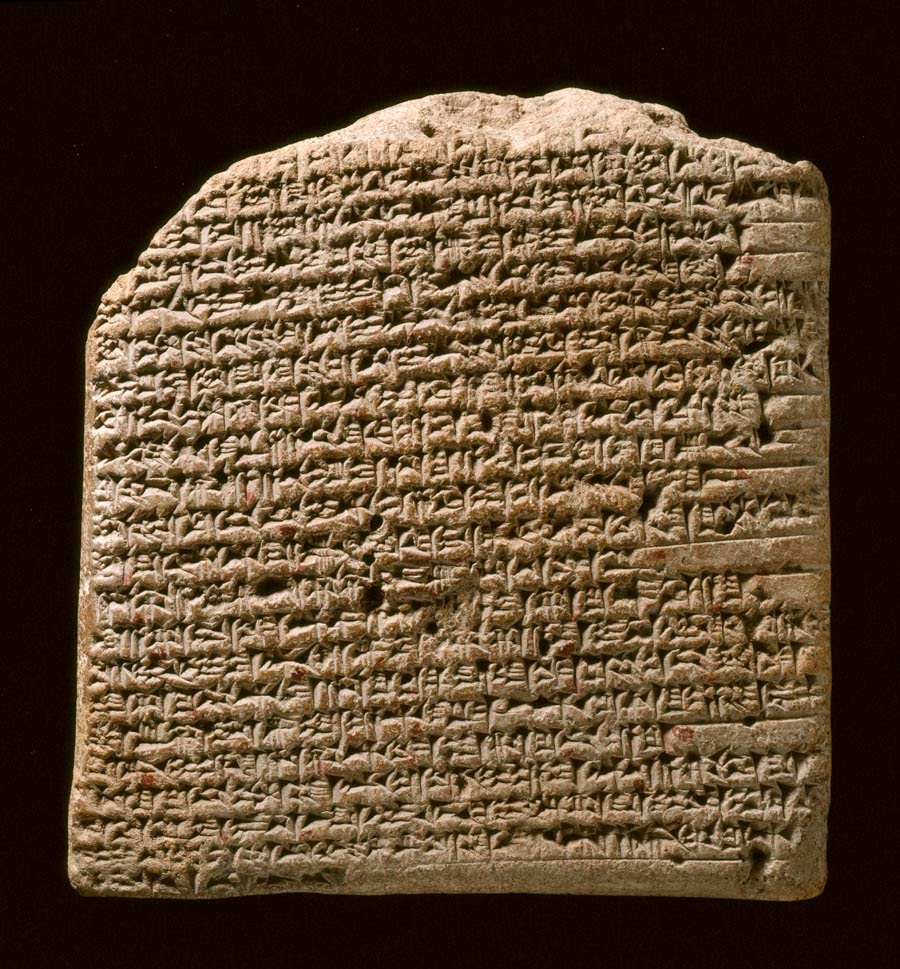
What if I told you this was an ancient version of the modern tablets we have today, like the iPad? You can kinda see it...It's handheld, you can write on it, bring it with you...it's more convenient than writing in the sand. It saves your document...But it's quite a stretch. What if I told you that the original maker of this ancient tablet knew all about modern tablets and their capabilities in the great complexity yet didn't have the precise words or concepts to articulate the vision he had of this amazing device. What if I said that despite the limitations of time, culture, language, and geography the maker embedded the concepts and details to the best of their ability for us to decipher in the future. You say that is ridiculous! I agree. This, in some sense, is concordism in action.

When interpreting the Bible there are several approaches one can take and it is not obvious which one to use. In fact, this is why there are different interpretations of texts by Christians. Depending on the assumptions you have going in you will come out with a different result because you are trying to find a different answer. Most of the time as an interpreter you do your best to put all of your own assumptions aside and let the text speak for itself. However, knowing the context of the writing is required to understand a text as well. It can be a tricky balance. An example is the book of Revelation. Should we take everything literally as dragons and rivers of blood, four horsemen, a woman swallowing the moon, and two beasts with crazy heads and horns, etc? I think not! I see this and know that it is apocalyptic imagery that it is symbolic and trying to communicate a message through a particular medium.

When we come to the early texts of Genesis I feel much the same way, and as with Revelation, I feel I still have much to learn and understand. However, There is a choice we need make that affects our interpretation. Does Genesis teach us science? I hold loosely to a sort of literary framework hypothesis approach to interpreting Genesis 1. I do not think Genesis is teaching us that the earth is young, but I also do not think that Genesis is teaching us that the earth is old! I do not hold to a strict harmonizing of the Genesis account and modern science. There are points where one has to ask questions about these issues theologically, but interpretively I see no assertions in the text itself one way or the other that require a particular position on the age of the earth or universe.

Those who hold that Genesis teaches the age of the earth fall into two categories; Young Earth or Old Earth. Both of these are concordist in their approach. Much of the debate surrounds Young Earth Creationists condemning the compromising old earth peeps and fighting the Naturalists/Atheists to no avail. I am a non-concordist, though I do think the earth and universe are old for scientific reasons. For an article outlining the strengths and weaknesses of both approaches, check out this article from BioLogos.org which includes the diagram shown below:

Concordist Interpretations: Non-concordist Interpretations:
Young Earth Interpretation
Creation occurred about 6,000 years ago, during six 24-hour days, in the order described. A scientific study of the earth should confirm this.
Proclamation Day Interpretation
The days of Genesis 1 took place in God’s throne room, wherein God proclaimed each step of creation. The throne-room days are not related to days or time periods on earth.
Gap Interpretation
Earth was created long ago (Gen 1:1), became “formless and empty” (Gen 1:2), and was restored about 6,000 years ago during six 24-hour days.
Creation Poem Interpretation
The number and ordering of the “days” of Genesis 1 are chosen for poetic and thematic reasons rather than historical reasons.
Day-Age Interpretation
Creation occurred over billions of years. Each “day” of Genesis 1 corresponds to a long epoch. Events occurred in the order given in the text, but stretched out over a longer time period.
Kingdom and Temple Interpretations
As the great King, God gives humans dominion as in a “land grant” covenant. Alternatively, God inaugurates the cosmos as his temple. In both cases, the text is not focused on the physical universe.
Appearance of Age Interpretation
Creation occurred about 6,000 years ago during six 24-hour days, but it was created to look like it had a long history of billions of years.
Ancient Near Eastern Cosmology Interpretation
Genesis 1 matches the physical picture of the world believed in Ancient Near East religions, but presents a dramatically different theological picture, proclaiming one God as creator of all rather than many gods.

Here are some other links of interest:
Report by the Presbyterian Creation Study Committee
Catholic view
Greek Orthodox view

Feb 28, 2014

Early church views on Creation in Genesis


I've said several times this week that there are many interpretations Genesis 1 so this post will direct you to quotes of theologians through the last 2,000 years. I also claimed that Ken Ham and Answers in Genesis think they are the only legitimate interpretation and are the ones aligned with historic Christianity. Here is the heading from their article titled, "Other 'Interpretations' of Genesis"
The purpose of this section is to define some of the interpretive schemes that have arisen since the idea of vast ages became popular in the late 18th and early 19th centuries. Please bear in mind that old-earth theologies were essentially non-existent prior to 1800. This fact alone provides strong evidence that these views are not derived from the Bible. Instead, they are an attempt to accommodate the long ages promoted by uniformitarian science. 
 From the outset, the title questions other approaches as actual interpretations. Then it describes them as 'schemes', claims they arose in the 18th and 19th centuries yet were only 'virtually' non-existent before 1800. Is that a fact? Are these views derived from the Bible? Or are they, as AIG claims, an attempt to accommodate modern science?

No. From the early church fathers onward, there has been a diversity of interpretations. In fact, the doctrine of Creation was not a priority for the early Christians. They were a little busy being slaughtered, fed to lions, and used as nightlights for the emperor. When they had time to talk there were more important issues such as the doctrine of the Trinity and the person of Jesus.

The key, once again, is that the views were diverse as pointed out with multiple quotes by this blogger. While it is true that many early Christians did think the earth was young, most of those held that the earth was 6,000 years old then. That would make the earth at least 8,000 years old today. Modern Young Earth Creationists base their belief of a 6,000 year old earth on the chronology of James Ussher and Dr. John Lightfoot.who wrote in the 17th century, not the early church as often asserted.

For another perspective on the early church's views, here is a 5 part blog post from 'Reasons to Believe'. They use what they call a 'Creation Model' approach to integrating science and the Christian faith.

Feb 26, 2014

John Walton - Origins Today - Genesis Through Ancient Eyes


As promised, here is the link to John Walton's discussion on reading Genesis through Ancient Near Eastern eyes:


Creation in Genesis and the Ancient Near East


This is an artistic depiction by Jonathan Walton of what the Ancient Near Eastern texts of the Bible, including Genesis 1 and others, actually describe. Looks a little different from the earth, doesn't it? Yet this is what the words these texts actually say (but perhaps Young Earth Creationists will claim this would be to read the text too literally).

The first step in reading any text is understanding the context. This includes not only where the passage is in relation to the whole, but the other writings of its day. In this case, other Ancient Near Eastern accounts of origins are significant and illuminating. For example, here is the Egyptian depiction of origins:


The most immediate difference is that there are figures of 'persons' embodying every aspect of creation. The god of the land, sky, etc. The Hebrew account is unique in excluding these personifications or any plurality of deities. There are, of course, other differences, but it is important to also notice the similarities. The same basic form remains with a flat earth, a sky being held up with sun, moon, and stars attached to it with waters above being held back. For a more thorough account of these similarities as well as one of the other Christian interpretations of the Genesis 1 text, read John Walton author of 'The Lost world of Genesis One." I will also post his online presentation in a separate post.


Feb 25, 2014

Bill Nye's opening argument

After Ken Ham delivered his non-evidence based 30 minutes that he somehow thinks justifies his claim that " "Creationism is the only viable model of historical science confirmed by observational science in today's modern scientific era," (which then puts the burden of proof on himself which is a horrible debate move) Bill Nye stepped up. This is a summary of Nye's points
  • Back to the question at hand, does Ham's model actually hold up?
  • Sea shell fossils created the rocks that the very building is built on. Millions of years of layers of ancient life.
  • There is snow ice with 680,000 layers of annual cycles.
  • A tree in sweden is over 9,000 years old. Even in California some are over 6,000 years old. Trees cannot survive under water.
  • You never find a 'lower' water animal mixed with a 'higher' water animal in the fossil record.
  • Points to the multiple types of skulls globally
  • How did all of the animals from Australia come from the ark in the Middle East with no evidence of them anywhere except Australia?
  • The math for Ham's model is preposterous based on a modest assessment of 16 million species today.

  • Several examples of why the ark is problematic: not enough space for 14,008 creatures, wood twisting in water would cause massive leaking, healthy living conditions unattainable, not enough  food, etc.
  • The Amphibious lung fish was predicted to be found in a particular place and it was: Tiktaalik
  • The Ken Ham cannot make predictions and get results.
  • Sexual reproduction in minnow fish combats infection and bacteria better than a-sexual reproduction
  • Prediction of the Big bang 'ecco'. Built a cosmic observatory to hear it and found it as predicted.
  • Elements of rubidium and strontium. Occurs in lava freezing allowing for the dating of fossils.
  • Billions of stars further than 6,000 light years away.
Instead of reaching for red herrings like differing opinions on dog species, bacteria on ecoli, or points not held by the opposition, Nye goes straight for the evidence. He not only gives clearly laid out reasons why he rejects a young earth and support for an old earth, he also goes out of his way to give reasons why there could not have been a global flood. This was not even necessary and yet because he knows it is actually held by Ham he went for it. Ham would have been wise to use this tactic and directed his attention to any evidence he thinks actually supports his view or can hold a candle to Nye's view.

There were a few points that I am well acquainted with which were brought up by Nye such as the distance of the stars, the age of rocks by various dating methods, fossil layers, snow ice layers, tree rings, and the layering of species. For other parts he expanded my per-existing knowledge. I knew most of the arguments against the ark and a global flood, but had not heard about how problematic a wooden ship that large would be for leaking. I knew there were problems with species going global post flood,  but hadn't thought through that there ought to be evidence of their travel not to mention the exponential species growth in such a short amount of time. There were also a lot more types of skulls on his diagram than I recall seeing gathered on a page.

What was most devastating to Ham, however, was the way Nye was able to point out Young Earth Creationism's lack of predictive power. Nye could point to the prediction of the Big Bang echo and that amazing amphibious lung fish fossil swamp in Canada. Perhaps Ham will have some sort of retort that could save some face in the later portion of this debate, but his position of a young earth is currently crushed. However, does Nye think he has done more than he actually has? He ended the debate saying, "Is Ken Ham's creation model viable? I say no! Absolutely not!" Then he pleaded for the listener not to raise scientifically illiterate children who don't understand their place int he cosmos, who don't understand natural law.

My question is whether Bill Nye thinks this is the normative Creation model for Christians or if he is narrowing the debate question as simply Creation according to Ham/AnswersInGenesis. It appears as though it is the latter. Let's hope so. It is clear that Ken Ham is deluded enough to equate his position as the foundation of all Christian faith and seems to think Nye is part of an evil empire of Naturalists. Perhaps Bill Nye will turn out to display more patience and grace out of the two because there was a mere hint of Naturalism in his entire presentation. From what I saw it was all science and no naturalistic attack against faith. In fact, I don't recall him ever denying the possibility that God created through evolution. There was no mention of God, Jesus, etc. There was no need to because Ham took the burden of proof. All Nye had to do was show that the earth was old and that Ham's claim was untenable.

Feb 24, 2014

Ken Ham's Opening Argument


Before I even listened/watched this debate, I knew a few things about it based on Facebook, Twitter, blogs, etc. I am also familiar with some of the Ken Ham and 'Answers in Genesis' material from their website. What bothered me the most was that Ken Ham appeared to have made the entire debate about the foundation of the Christian faith. He seems to think his position of Young Earth Creationism is the doctrine of Creation; the only one that truly holds to the inerrancy of Scripture, the authority of the Bible, etc. Actually witnessing his opening argument confirmed that he is operating under several assumptions and implicitly, if not explicitly,  misrepresenting his view as the Christian view to a watching world.

Here is a summary of what he said:
  • "Creationism is the only viable model of historical science confirmed by observational science in today's modern scientific era"
  • We need to define the terms 'science' 'creationism' and 'evolution'
  • "Biblical Creationism" = Young Earth Creationism. The earth is 6,000 years old
  • Creationists and Naturalists have the same observational data: geology, radioactive decay, etc. The battle is over the interpretation of data due to differing worldviews or starting points.
  • Kids aren't being taught to think critically
  • The Bible's account gives predictions that can be tested: Intelligent life, each kind producing after its own kind, one human race, global flood, tower of babel, young universe.
  • cites a recent University of California research claim that rejects a theory about simultaneous evolution of dogs from wolves.
  • "Evolution" has been 'highjacked' to mean molecules to man instead of simply change over time. Ham affirms the later, but not the former.
  • Molecules to man is in textbooks as evolution, but it is not observable science
  • Naturalism is being taught in textbooks to children as a worldview, not simply evolution
  • He cites a recent claim of some sort that bacteria growing on ecoli proving evolution, but the actual report discussed that the information was already there and simply switches on and off.
  • He pulls out the fact that early evolutionary textbooks promoted Caucasians as the superior evolutionary race, but the genome project proved there is only one race, the human race.
  • Claims we can't observe the age of the earth, its origins, or historical science
  • Creation = 'literal' accounts of the Bible (which is how Jesus read it) including: No death before the fall (corruption), a catastrophic global flood, Confusion at the tower of babel, Christ redeemed us, and there will be a future consummation of a new heavens and new earth.
  • Genesis is the foundation for a Christian's entire worldview.
  • He claims that Genesis is the basis for positions on issues such as homosexuality, euthanasia, and abortion.
Ham's opening has staggering assertions, points I would agree with, and questions I simply don't have the scientific knowledge to address either way. First off, his overall claim that "Creationism is the only viable model of historical science confirmed by observational science in today's modern scientific era" did not have sufficient support or examples. If he wants to claim it as the 'only' viable model and that it is 'confirmed' by observational science, he can't cite a few errors by an alternate view, make broad claims about his own, then assume the job is done. Aside from whether the Bible actually claims a global flood or a young universe in the first place, it is far from confirmed by observational science. By far most scientists whether Christian or not view the earth and stars and being billions of years old. Opinions on when humanity came into existence are certainly more diverse, but rocks and stars? Not so much. He claims we can't know the age of the earth from observational science. Really? I wanted to ask him whether or not we can know the age of Ken Ham based on observational science.

Ham runs into further mistakes in the way he uses the errors of some evolutionists. Just because a university rejects a certain view about the uprising of dog species does not disprove the overall construct of a common ancestor. His claim regarding one writer mistakenly claiming that 'bacteria starting to grow on ecoli is another thorn in the side of creationists' is simply proof that you don't need to be a Young Earth Creationist to glaze over the nuances of a text to make a rhetorical point. The most staggering part of his opening was when he brought out the racism found in early textbooks teaching evolution. While this is historically true, it is not held by evolutionists today and is far more likely to be a product of cultural assumption than scientific data in the first place. Furthermore, the citing of the human genome project disproving 'racism' scientifically is a huge mistake because the project itself has been the largest source of proof for humans having a common ancestor with other mammals since the data has been compiled (Did you know we have DNA for producing egg yolk? How does that contribute to us producing after our own kind?).

As I said before, the main thing that bothers me is not that Ham makes claims on behalf of himself, Answers in Genesis, or Young Earth Creationists at large. My problem is that he portrays himself as normative of Christians and the only legitimate interpreter of not only scientific data, but the Bible and Christian doctrine. I think he is wrong to make the exclusivity claims he does about science based on limited knowledge. I know he is wrong about his exclusivity claims about the Bible and doctrine based on being part of his faith community, training in biblical studies, and much research into this particular subject due to personal interest. The fact is that his particular position did not exist for much of Christian history and that there have been multiple interpretations of Genesis since well before Jesus even came on the scene. To that point, his claim that Genesis is the foundation of the Christian faith is problematic not only because he basically means 'his interpretation of Genesis', but also because the foundation of Christian faith is the claim that Jesus was raised from the dead. That is a whole other issue, but clearly he is overstating his case.

Where I do find agreement with Ham is the issue of conflating Naturalism with Evolution. I did not go to public school or study in the sciences, but based on literature, interviews, and discussions with those in the field it does seem as though science class oversteps its bounds and, at times, starts teaching philosophy. Teaching and using methodological naturalism should be normative, but modern science is supposed to be answering What, Where, When, and How. When it attempts to make claims on Who or Why, it goes beyond its own scope. I have also found that scientists are painfully unaware of their own philosophical assumptions. A friend studying Bio-chem did not even have a class on philosophy of science until the masters level. This is troubling and frustrating and Ken Ham knows about it. But he does not talk about it in this way. He simply states that there are different worldviews that interfere with the interpretation of data. He makes a a big deal about the difference between historical and observational science, yet I wonder if he really means that Historical science = Origins. In my opinion, modern science cannot answer the question of origins whether you are a Naturalist or Creationist, which is why the debate question is problematic to begin with. We'll see where the debate goes from here.

Any thoughts?
What has your experience been in science class?

Feb 5, 2014

Nye vs Ham


Last night there was a debate that has sparked far more media attention than I thought it would. This is not a joke. Bill Nye (the science guy) debated Ken Ham (of 'Answers in Genesis') on the following question:
"Is creation a viable model of origins in today's modern scientific era?"
Based on what I have read or seen of their previous work I don't hold to either of their positions and will likely find points of agreement on both sides. I read a few blogs of varying perspectives and opinions about the debate leading up to it, but have not yet watched it. I plan to do so over the next few days and write my thoughts. I will probably do this over several posts as I am aware there are many subjects and issues to address and I will likely have to watch the debate in sections due to its length. Here it is in full: