Showing posts with label origins. Show all posts

Mar 21, 2014

What is to become of them?


I wrote yesterday about the rebuttals/counter-rebuttals of Nye and Ham and something Ham touched on but he wouldn't talk about further really troubled me. That something was "those Christians" who don't agree with him. He refused to discuss this issue, even when directly challenged by Bill Nye: "There are Christians that don't accept that the earth could somehow be this extraordinarily young age because of all the evidence around them. And so, what is to be come of them in your view?"

This is what Ham had said to prompt that challenge:
"They, there are a lot of Christians out there that believe in millions of years, but I'd say they have a problem. I'm not saying they're not Christians...because salvation is conditional on faith in Christ not the age of the earth, but there's an inconsistency with what the Bible teaches. If you believe in millions of years, you've got death and bloodshed, suffering and disease over millions of years leading up to man because that's what you see in the fossil record. The Bible makes if very clear; death is a result of man's sin. In fact, the first death was in the garden when God killed an animal, clothed Adam and Eve; the first blood sacrifice pointing toward what would happen through Jesus Christ; one who would die once and for all."
He went on to give examples in the fossil record of carnivores, disease, and thorns. He says that we are told in the Bible that all creatures were vegetarians until after the flood and that disease is not 'good' and thorns were a result of the fall. Since the Bible tells us these things that contradicts the millions of years theory of the age of the earth and they are incompatible.

This issue of death is a real problem that needs to be addressed, but there are problems Ham must face as well. These are problems Nye is pointing out, which Ham is skirting one by one for the most part. He's not answering the questions. It seems to me he has more problems to work through with a young earth than those who do not hold his view. Perhaps he will get into it more in the question and answer period, but I want to know what he thinks will become of those who don't agree with him. Are they refused membership in the church? Are they removed or prevented from being in leadership? Are they allowed to be pastors or professors? Are they excommunicated altogether until they fall in line with his view? What is to become of them? It's a big question and a big problem for Ham and the church of North America in general. Sadly, the story has often been a clarification of doctrinal statement, the cracking of the whip, and the dismissal of pastors and teachers. You can read about one recent example here.

Mar 20, 2014

Nye vs Ham - Rebuttals and Counter Rebuttals


I'm finally getting back to the Nye vs Ham debate.I've already covered preliminaries here and here as well as the opening arguments of Ken Ham and Bill Nye. Today I'm covering their five minute rebuttals and counter rebuttals. Again, you can watch the entire debate on YouTube here. As with other posts, I'll summarize the content and then make some remarks afterward.

Ken Ham
  • Claims we cannot observe the age of the earth because that is historical science
  • The Bible is the only source of historical science
  • The age of the earth is determined by the six days of creation and adding up the genealogies
  • We do observe decay, but when we use it to talk about the past that is a problem
  • There are 3 assumptions with radiometric dating: That we know the starting number of parent atoms, that all daughter atoms come from parent atoms, and that the rate of decay has been constant
  • Some Christians do believe in an old earth and they're still saved because that is through faith in Jesus and not in the age of the earth, but there is a problem because they are not consistent with the Bible.
  • Problems: Death before the fall, carnivores before the flood, brain tumors and thorns in the fossil record before the fall would have been.
  • There is one infallible dating method: the Word of God from someone who was there.
I find it strange that Ham would try to make a claim that we cannot observe the age of the earth and yet when answering the question,"Is creation a viable model of origins in today's modern scientific era?", he answers 'yes'. It seems like his creation model has no room for any modern science based on observation. I suppose this means he reject modern science wholesale, yet in other places he affirms science for other purposes of gaining knowledge. It is an interesting and bold move to deny that we can know the age of something based on observation. I also think he makes similar bold claims about radioactive decay. Essentially he denies constant rates of decay and must assert that God created with the appearance of age (which I think makes God deceptive).

I was glad to hear him include other Christians that don't share his view in some capacity, but am troubled by his assertion that we are not consistent with our treatment of the Bible. That is a pretty bold claim that he left untouched and is well beyond the capability and knowledge of Nye to address in this debate. He did bring up some very legitimate problems that need to be dealt with soon thereafter, such as death before the fall, carnivores, thorns, etc. I'll write a post in the future addressing the death issue in particular.
 
Bill Nye
  • He asks: Are fish sinners? Why do they die?
  • He wonders why Ham keeps asserting that we cannot observe the past. That is all that happens in astronomy and we actually do this all of the time. The speed of light and sound requires that we see and observe things in every day life that have already happened in the past.
  • You cannot separate the natural laws of the present from the past. How are they different?
  • Gives a telephone analogy about the Bible being an unreliable record
  • If we accept the American English bible as interpreted by Ham as more respected than what can be observed in your backyard, that is very troubling.
I found some of Nye's comments naive and condescending such as asking if fish were sinners.The telephone analogy about the transmission and reliability of the Bible is ignorant to that field of study. We have incredibly accurate copies of original documents and the discovery of additional manuscripts in the past century as well as historical background information means that our access to an accurate translation in our own language hasn't been this good since the earlier centuries of the church (in my opinion).

As for his assertions about being able to observe the age of the earth and the past, he makes good points. This distinction of historical science is unique to Ham and claiming that it simply has to be that way is not a scientific claim, it is a faith claim that denies consistency with reality. The separation of the past and present natural law is a huge problem. Not all YEC people do this, but Ham, apparently, does.

Ken Ham
  • We do have constant natural laws and they only fit in a worldview with a Law Giver
  • There are other Phd's in Ham's camp, it's not just Ham
  • God created 'kinds' not species so there were only 1,000 kinds on the ark
  • We didn't see tree layers forming or ice layers forming so we can't use those
  • Starlight gives problems for everyone which is why they have inflation theories, etc.
Most of this section seemed to me as though Ham was simply being evasive. He seems to contract himself from early in affirming that there are natural laws that have been constant. He tags on that natural law is only possible in a worldview where there is a Law Giver, ie: God. I think it would be more accurate to say that this worldview is compatible with consistent natural laws and provides explanatory force philosophically. Saying it is the only worldview where natural law is possible seems a bit off to me.

Saying that there were 1,000 'kinds' on the ark isn't much of a solution to Nye's challenge. Saying we didn't see the tree layers or ice layers forming and so they can't be used is bizarre. Saying that starlight gives problems for everyone is also evasive.

Bill Nye
  • "Thank you Mr. Ham, but I am completely unsatisfied."
  • If there were only 1,000 'kinds' on the ark, there would have to have been 40 new species created every single day since the flood in order for there to be the number of species we now have.
  • The fundamental disagreement is about what you can actually prove.
  • Have all relationships between animals changed only after the flood?
  • What becomes of other religious people who don't accept your view?
  • Ham claims to be a scientist, not a theologian? Nye asks for origins according to science and Ham gives be bible verses. His scientific theory of origins is based on the Old Testament.
  • When scientists find that a model doesn't hold water they throw it away. Provide an explanation that changes the model or theory about the age of the earth, evolution, etc. and you will be applauded and praised for it by scientists.
 It was a spectacularly appropriate opening line, which is why I was sure to quote it accurately. The math about getting to the appropriate number of species from the ark until today is a staggering challenge to the question of the flood, which I'm not dealing with in this series. For now I'll say that there are many Christians who believe in a local flood instead of a global one. I've been agnostic on this issue for awhile and haven't studied it enough to have a firm opinion. The use of the term 'world' and 'earth' is much looser than it sounds to our modern English ears. When we consider that the Hebrew writers had no concept of a 'globe' at all (they thought the world was flat) it becomes easier to conceive of the story as a local flood in their known 'world' or 'earth' (I'm not even sure which Hebrew word it is...I told you I haven't studied enough to have a firm opinion.).

The fundamental disagreement is definitely about what is even possible to be proven scientifically. I do hold to the Bible as the primary authority, but we have to read it on its own terms and not ones we impose upon it. We also have to explain how it is consistent with reality, which YEC peeps need to do better than Ham's evasiveness in this rebuttal period of the debate. I don't think the Bible asserts an age of the earth either young or old. I don't think that is what Genesis is about and Ham's interpretation of these texts are not an adequate engagement to the question of their debate at all. Nye is right to point out what Ham is doing. Ham is doing theology, not science.

Mar 18, 2014

New Evidence for Big Bang inflation and the Multiverse


Pretty interesting stuff!
"We might never know what happened before inflation, at the very beginning, because inflation erases everything that came before it. All the chaos and randomness of the primordial moment are swept away, forever out of our view."
An interesting choice of words for an interesting discovery. The space ripple essentially confirms the inflation theory of the Big Bang in that there is still a rapid expansion going on. The article explains that this is huge for science because it helps our understanding of many areas including how gravity works. This also supports the theory of a muftiverse, which I've been hearing more and more about in various circles.

How does this effect a view of God as Creator or Designer? It's a non-starter, says Bill Craig. Most of his post is over my head, but he sure knows his cosmology:
The idea that our universe is just a part of a wider multiverse is an expression of what I call the Many Worlds Hypothesis (MWH).... If MWH is to commend itself as a plausible hypothesis, then some plausible mechanism for generating the many worlds needs to be to be explained.  The best shot at providing a plausible mechanism comes from inflationary cosmology, which is often employed to defend the view that our universe is but one domain (or “pocket universe”) within a vastly larger universe, or multiverse.
The bottom line is that a multiverse simply pushes the question of origins back further

Mar 5, 2014

Is creation out of nothing a doctrine 'ex nihilo'?

 
Today I will continue to cover the reasons why I reject Young Earth Creationism and believe the earth to be quite old. If you're looking for biblical evidence, reasons, and compatibility you'll find some here. I covered some scientific evidence yesterday including radiometric dating and ice layers.

This is going to have to be a series of posts because there is a lot to cover even off the top of my head so today I will start with the lack of texts that God created the universe out of nothing. I do believe God made the universe out of nothing, but when I examine the Bible there is actually no text that clearly and explicitly states creation 'Ex Nihilo', that is, 'out of nothing'. And before we get too far into this point it is worth saying that the claims of some from the scientific community that the universe indeed did come out of nothing isn't the same thing. For them, 'Nothing' is actually 'Something' such as a quantum vacuum. The move has been deeply criticized for highjacking a term used in philosophy and theology and creating more confusion than light.

Creation 'ex nihilo' is essentially a theological conclusion based upon biblical statements about the nature of God in relation to creation. There are various views on this front: Pantheism, Panentheism, and Theism.
This picture illustrates the differences fairly well. In the middle we see that the universe simply is God, which is pantheism. To the right, we see that the universe is God, but God is still beyond it, or larger than it, or not exhausted by it, which is panentheism. To the left is Theism, which shows that God is completely 'other than' the universe. I think this image does lean more toward a deism, however, because it looks like God is spatially transcendent or beyond the universe with no interaction as though there is a great distance. The Jewish and Christian view of God and creation is one where God is not the universe in any sense, yet sustains it and is immanent, or near, while still transcendent beyond it. The Bible is also clear that God is the only thing or being that is existent from eternity. This is classic theology and because of this view of God and creation it is said that because the universe is in no sense God it must have come into being out of nothing and that such an act was performed by God as the cause.

'But what about Genesis 1?' you ask. This is what it says:
"In the beginning God created the heavens and the earth. Now the earth was formless and empty, darkness was over the surface of the deep, and the Spirit of God was hovering over the waters." (Gen 1:1-2 NIV)
Before the first day where God said let there be light we have an earth without form and deep waters. This is not creation out of nothing. The rest of this creation narrative describes God bringing order out of the chaos of the primordial waters and darkness. If you read through you will notice that there simply is not point in which God creates water. He separates it with a solid dome so that some is held back in the sky for rainfall. He makes dry land appear by gathering the waters together (the land was apparently also already there and was not 'created out of nothing' but made to appear by moving the water). The water was already there and God is controlling it; bringing order. There are similar problems with the other creation texts in the Bible. They simply do not make overt proclamation about the first moment of something from nothing.

Millard J Erickson agrees with my assessment that the Bible does not explicitly teach this doctrine saying, "Although the language in the Old Testament is not conclusive, the idea of ex nihilo creation can be found in a number of New Testament passages where the aim is not primarily to make a statement about the nature of creation. In particular, there are numerous references to the beginning of the world or the beginning of creation." (Introducting Christian Doctrine 2nd ed. 2001, pg 131). The phrases in the New Testament are pretty much variations of "from the beginning of the world..." or "since the creation of the world..." Such instances are incidental and not actually teaching creation ex nihilo, yet the implication of these types of statements make it reasonable to hold to the doctrine by inference.

This may seem like a major tangent and have nothing to do with whether or not the earth is young, but stay with me. Even conservative theologians agree that there are only implications from texts and that many of the clearer sounding texts aren't teaching about creation. This means that the creation texts themselves, and particularly the oldest ones, are not giving an account of the moment where something came out of nothing. It is possible to believe that these texts are describing this event, but there is nothing in the texts themselves that requires us to interpret the texts in this way. That means that the Bible's account of creation cannot be giving a clear indication of the age of the universe.

Mar 3, 2014

Concordism = making ancient texts teach modern science


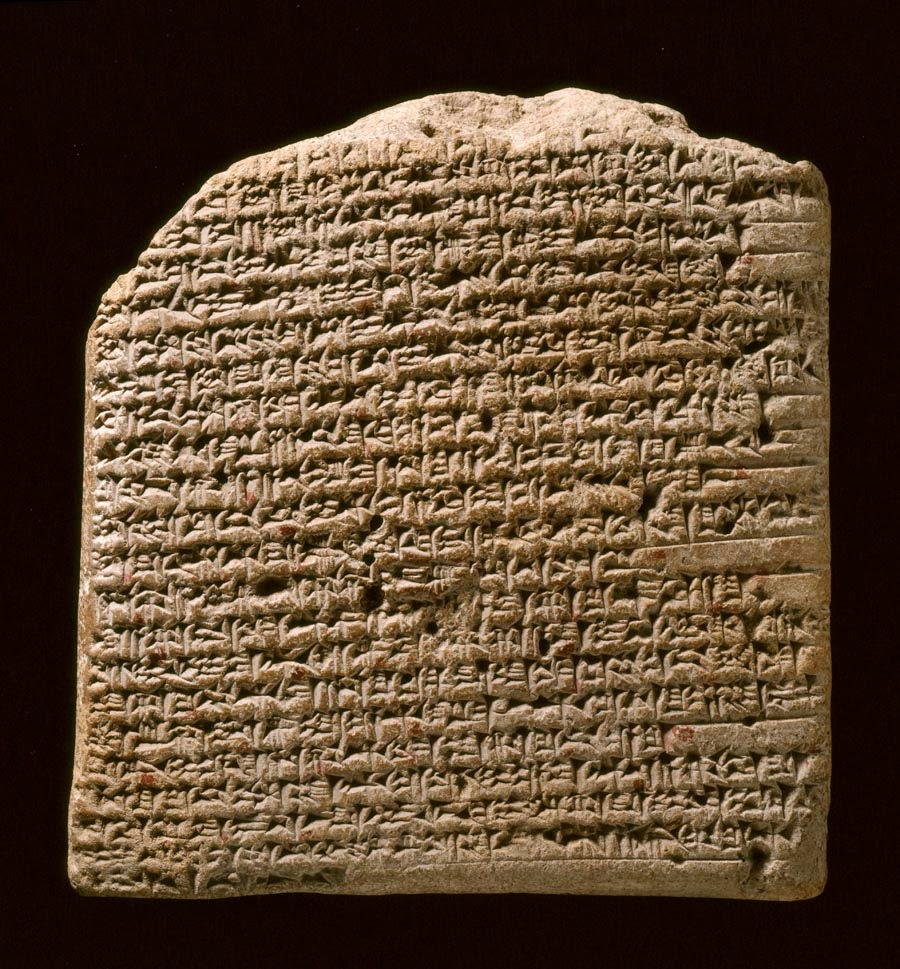
What if I told you this was an ancient version of the modern tablets we have today, like the iPad? You can kinda see it...It's handheld, you can write on it, bring it with you...it's more convenient than writing in the sand. It saves your document...But it's quite a stretch. What if I told you that the original maker of this ancient tablet knew all about modern tablets and their capabilities in the great complexity yet didn't have the precise words or concepts to articulate the vision he had of this amazing device. What if I said that despite the limitations of time, culture, language, and geography the maker embedded the concepts and details to the best of their ability for us to decipher in the future. You say that is ridiculous! I agree. This, in some sense, is concordism in action.

When interpreting the Bible there are several approaches one can take and it is not obvious which one to use. In fact, this is why there are different interpretations of texts by Christians. Depending on the assumptions you have going in you will come out with a different result because you are trying to find a different answer. Most of the time as an interpreter you do your best to put all of your own assumptions aside and let the text speak for itself. However, knowing the context of the writing is required to understand a text as well. It can be a tricky balance. An example is the book of Revelation. Should we take everything literally as dragons and rivers of blood, four horsemen, a woman swallowing the moon, and two beasts with crazy heads and horns, etc? I think not! I see this and know that it is apocalyptic imagery that it is symbolic and trying to communicate a message through a particular medium.

When we come to the early texts of Genesis I feel much the same way, and as with Revelation, I feel I still have much to learn and understand. However, There is a choice we need make that affects our interpretation. Does Genesis teach us science? I hold loosely to a sort of literary framework hypothesis approach to interpreting Genesis 1. I do not think Genesis is teaching us that the earth is young, but I also do not think that Genesis is teaching us that the earth is old! I do not hold to a strict harmonizing of the Genesis account and modern science. There are points where one has to ask questions about these issues theologically, but interpretively I see no assertions in the text itself one way or the other that require a particular position on the age of the earth or universe.

Those who hold that Genesis teaches the age of the earth fall into two categories; Young Earth or Old Earth. Both of these are concordist in their approach. Much of the debate surrounds Young Earth Creationists condemning the compromising old earth peeps and fighting the Naturalists/Atheists to no avail. I am a non-concordist, though I do think the earth and universe are old for scientific reasons. For an article outlining the strengths and weaknesses of both approaches, check out this article from BioLogos.org which includes the diagram shown below:

Concordist Interpretations: Non-concordist Interpretations:
Young Earth Interpretation
Creation occurred about 6,000 years ago, during six 24-hour days, in the order described. A scientific study of the earth should confirm this.
Proclamation Day Interpretation
The days of Genesis 1 took place in God’s throne room, wherein God proclaimed each step of creation. The throne-room days are not related to days or time periods on earth.
Gap Interpretation
Earth was created long ago (Gen 1:1), became “formless and empty” (Gen 1:2), and was restored about 6,000 years ago during six 24-hour days.
Creation Poem Interpretation
The number and ordering of the “days” of Genesis 1 are chosen for poetic and thematic reasons rather than historical reasons.
Day-Age Interpretation
Creation occurred over billions of years. Each “day” of Genesis 1 corresponds to a long epoch. Events occurred in the order given in the text, but stretched out over a longer time period.
Kingdom and Temple Interpretations
As the great King, God gives humans dominion as in a “land grant” covenant. Alternatively, God inaugurates the cosmos as his temple. In both cases, the text is not focused on the physical universe.
Appearance of Age Interpretation
Creation occurred about 6,000 years ago during six 24-hour days, but it was created to look like it had a long history of billions of years.
Ancient Near Eastern Cosmology Interpretation
Genesis 1 matches the physical picture of the world believed in Ancient Near East religions, but presents a dramatically different theological picture, proclaiming one God as creator of all rather than many gods.

Here are some other links of interest:
Report by the Presbyterian Creation Study Committee
Catholic view
Greek Orthodox view

Feb 28, 2014

Early church views on Creation in Genesis


I've said several times this week that there are many interpretations Genesis 1 so this post will direct you to quotes of theologians through the last 2,000 years. I also claimed that Ken Ham and Answers in Genesis think they are the only legitimate interpretation and are the ones aligned with historic Christianity. Here is the heading from their article titled, "Other 'Interpretations' of Genesis"
The purpose of this section is to define some of the interpretive schemes that have arisen since the idea of vast ages became popular in the late 18th and early 19th centuries. Please bear in mind that old-earth theologies were essentially non-existent prior to 1800. This fact alone provides strong evidence that these views are not derived from the Bible. Instead, they are an attempt to accommodate the long ages promoted by uniformitarian science. 
 From the outset, the title questions other approaches as actual interpretations. Then it describes them as 'schemes', claims they arose in the 18th and 19th centuries yet were only 'virtually' non-existent before 1800. Is that a fact? Are these views derived from the Bible? Or are they, as AIG claims, an attempt to accommodate modern science?

No. From the early church fathers onward, there has been a diversity of interpretations. In fact, the doctrine of Creation was not a priority for the early Christians. They were a little busy being slaughtered, fed to lions, and used as nightlights for the emperor. When they had time to talk there were more important issues such as the doctrine of the Trinity and the person of Jesus.

The key, once again, is that the views were diverse as pointed out with multiple quotes by this blogger. While it is true that many early Christians did think the earth was young, most of those held that the earth was 6,000 years old then. That would make the earth at least 8,000 years old today. Modern Young Earth Creationists base their belief of a 6,000 year old earth on the chronology of James Ussher and Dr. John Lightfoot.who wrote in the 17th century, not the early church as often asserted.

For another perspective on the early church's views, here is a 5 part blog post from 'Reasons to Believe'. They use what they call a 'Creation Model' approach to integrating science and the Christian faith.

Feb 27, 2014

Dr. Dr. Dr. Lamoureux and Origins

Here is yet another Christian who holds to an old earth and common ancestry. That title was no error. He holds a doctoral degree in evolutionary biology, evangelical theology, and dentistry. His undergrad was a Bachelor of Science. He also holds a masters in Christian studies and an MDiv.. You can find his bio here.

He is the author of "I love Jesus and I accept evolution"

He has published a paper online called EVOLUTIONARY CREATION: MOVING BEYONDTHE EVOLUTION VERSUS CREATION DEBATE

He has posted free online web lectures on
Beyond the "Evolution" vs. "Creation" Debate 
The Bible & Ancient Science
Intelligent Design: Delusion, Uncertainty, or Divine Revelation?
Was Adam a Real Person?  

He has also posted versions for high school students that are less technical.  
Intelligent Design: Delusion or Divine Revelation?
The Bible & Ancient Science
Beyond the "Evolution" vs. "Creation" Debate

I have not personally viewed all of the contents or necessarily agree on every point, but I think it is very important to circulate alternate Christian views on this subject. As a Christian I feel compelled to counter the sometimes obtuse claims and ridiculous content sometimes presented in perspectives such as Ken Ham and Answers in Genesis.

Feb 24, 2014

Ken Ham's Opening Argument


Before I even listened/watched this debate, I knew a few things about it based on Facebook, Twitter, blogs, etc. I am also familiar with some of the Ken Ham and 'Answers in Genesis' material from their website. What bothered me the most was that Ken Ham appeared to have made the entire debate about the foundation of the Christian faith. He seems to think his position of Young Earth Creationism is the doctrine of Creation; the only one that truly holds to the inerrancy of Scripture, the authority of the Bible, etc. Actually witnessing his opening argument confirmed that he is operating under several assumptions and implicitly, if not explicitly,  misrepresenting his view as the Christian view to a watching world.

Here is a summary of what he said:
  • "Creationism is the only viable model of historical science confirmed by observational science in today's modern scientific era"
  • We need to define the terms 'science' 'creationism' and 'evolution'
  • "Biblical Creationism" = Young Earth Creationism. The earth is 6,000 years old
  • Creationists and Naturalists have the same observational data: geology, radioactive decay, etc. The battle is over the interpretation of data due to differing worldviews or starting points.
  • Kids aren't being taught to think critically
  • The Bible's account gives predictions that can be tested: Intelligent life, each kind producing after its own kind, one human race, global flood, tower of babel, young universe.
  • cites a recent University of California research claim that rejects a theory about simultaneous evolution of dogs from wolves.
  • "Evolution" has been 'highjacked' to mean molecules to man instead of simply change over time. Ham affirms the later, but not the former.
  • Molecules to man is in textbooks as evolution, but it is not observable science
  • Naturalism is being taught in textbooks to children as a worldview, not simply evolution
  • He cites a recent claim of some sort that bacteria growing on ecoli proving evolution, but the actual report discussed that the information was already there and simply switches on and off.
  • He pulls out the fact that early evolutionary textbooks promoted Caucasians as the superior evolutionary race, but the genome project proved there is only one race, the human race.
  • Claims we can't observe the age of the earth, its origins, or historical science
  • Creation = 'literal' accounts of the Bible (which is how Jesus read it) including: No death before the fall (corruption), a catastrophic global flood, Confusion at the tower of babel, Christ redeemed us, and there will be a future consummation of a new heavens and new earth.
  • Genesis is the foundation for a Christian's entire worldview.
  • He claims that Genesis is the basis for positions on issues such as homosexuality, euthanasia, and abortion.
Ham's opening has staggering assertions, points I would agree with, and questions I simply don't have the scientific knowledge to address either way. First off, his overall claim that "Creationism is the only viable model of historical science confirmed by observational science in today's modern scientific era" did not have sufficient support or examples. If he wants to claim it as the 'only' viable model and that it is 'confirmed' by observational science, he can't cite a few errors by an alternate view, make broad claims about his own, then assume the job is done. Aside from whether the Bible actually claims a global flood or a young universe in the first place, it is far from confirmed by observational science. By far most scientists whether Christian or not view the earth and stars and being billions of years old. Opinions on when humanity came into existence are certainly more diverse, but rocks and stars? Not so much. He claims we can't know the age of the earth from observational science. Really? I wanted to ask him whether or not we can know the age of Ken Ham based on observational science.

Ham runs into further mistakes in the way he uses the errors of some evolutionists. Just because a university rejects a certain view about the uprising of dog species does not disprove the overall construct of a common ancestor. His claim regarding one writer mistakenly claiming that 'bacteria starting to grow on ecoli is another thorn in the side of creationists' is simply proof that you don't need to be a Young Earth Creationist to glaze over the nuances of a text to make a rhetorical point. The most staggering part of his opening was when he brought out the racism found in early textbooks teaching evolution. While this is historically true, it is not held by evolutionists today and is far more likely to be a product of cultural assumption than scientific data in the first place. Furthermore, the citing of the human genome project disproving 'racism' scientifically is a huge mistake because the project itself has been the largest source of proof for humans having a common ancestor with other mammals since the data has been compiled (Did you know we have DNA for producing egg yolk? How does that contribute to us producing after our own kind?).

As I said before, the main thing that bothers me is not that Ham makes claims on behalf of himself, Answers in Genesis, or Young Earth Creationists at large. My problem is that he portrays himself as normative of Christians and the only legitimate interpreter of not only scientific data, but the Bible and Christian doctrine. I think he is wrong to make the exclusivity claims he does about science based on limited knowledge. I know he is wrong about his exclusivity claims about the Bible and doctrine based on being part of his faith community, training in biblical studies, and much research into this particular subject due to personal interest. The fact is that his particular position did not exist for much of Christian history and that there have been multiple interpretations of Genesis since well before Jesus even came on the scene. To that point, his claim that Genesis is the foundation of the Christian faith is problematic not only because he basically means 'his interpretation of Genesis', but also because the foundation of Christian faith is the claim that Jesus was raised from the dead. That is a whole other issue, but clearly he is overstating his case.

Where I do find agreement with Ham is the issue of conflating Naturalism with Evolution. I did not go to public school or study in the sciences, but based on literature, interviews, and discussions with those in the field it does seem as though science class oversteps its bounds and, at times, starts teaching philosophy. Teaching and using methodological naturalism should be normative, but modern science is supposed to be answering What, Where, When, and How. When it attempts to make claims on Who or Why, it goes beyond its own scope. I have also found that scientists are painfully unaware of their own philosophical assumptions. A friend studying Bio-chem did not even have a class on philosophy of science until the masters level. This is troubling and frustrating and Ken Ham knows about it. But he does not talk about it in this way. He simply states that there are different worldviews that interfere with the interpretation of data. He makes a a big deal about the difference between historical and observational science, yet I wonder if he really means that Historical science = Origins. In my opinion, modern science cannot answer the question of origins whether you are a Naturalist or Creationist, which is why the debate question is problematic to begin with. We'll see where the debate goes from here.

Any thoughts?
What has your experience been in science class?

Feb 5, 2014

Nye vs Ham


Last night there was a debate that has sparked far more media attention than I thought it would. This is not a joke. Bill Nye (the science guy) debated Ken Ham (of 'Answers in Genesis') on the following question:
"Is creation a viable model of origins in today's modern scientific era?"
Based on what I have read or seen of their previous work I don't hold to either of their positions and will likely find points of agreement on both sides. I read a few blogs of varying perspectives and opinions about the debate leading up to it, but have not yet watched it. I plan to do so over the next few days and write my thoughts. I will probably do this over several posts as I am aware there are many subjects and issues to address and I will likely have to watch the debate in sections due to its length. Here it is in full: