Showing posts with label Christian. Show all posts

Apr 21, 2014

An atheist's view on life?

I'm back! Got a new laptop (love it! Buy a refurbished Macbook Air. You'll be glad you did). I saw the following descending/ascending 'poem' floating around online. I wrote a few comments on what I think atheists would disagree with and was wondering if any of you had something to add. 


I had claimed that in speaking with the atheists I knew, they would find disagreement with some items in this. I spouted off three at a glance:

1. That it is just foolish to think there is a God with a cosmic plan. Denying God's existence does not assert or require that you think another's belief is 'just foolish.'

2. That being deserving of hell "is a lie meant to enslave me to those in power." It is not a point that gives power to 'religious authorities' but to God. I'd say it is a popular belief, but anyone who I've challenged on it has never given me any actual reason to believe it. The early church? No. They were martyrs and far from having any power or influence. The crusades? They used religion to control people by lying, but this is an abuse. Present day? Maybe in cults and fringe groups there is more abuse and many Christian (embarrassingly) us it as a fear tactic to 'convert' people when they 'evangelize'. However,  any time I've explained it they have been silent with no logical connection to draw.

3. And the biggest one: "Our existence has no grand meaning or purpose." They hate. hate. hate this one. I think it is very difficult because they believe in meaning and purpose, but have no good reason to assert it aside from a radical faith statement hanging in mid air in a random universe of chance.

What do you think? Anything to add? Is there truth to the opposite reading about Christians? Are there also false statements in there? Leave a comment.

Mar 21, 2014

What is to become of them?


I wrote yesterday about the rebuttals/counter-rebuttals of Nye and Ham and something Ham touched on but he wouldn't talk about further really troubled me. That something was "those Christians" who don't agree with him. He refused to discuss this issue, even when directly challenged by Bill Nye: "There are Christians that don't accept that the earth could somehow be this extraordinarily young age because of all the evidence around them. And so, what is to be come of them in your view?"

This is what Ham had said to prompt that challenge:
"They, there are a lot of Christians out there that believe in millions of years, but I'd say they have a problem. I'm not saying they're not Christians...because salvation is conditional on faith in Christ not the age of the earth, but there's an inconsistency with what the Bible teaches. If you believe in millions of years, you've got death and bloodshed, suffering and disease over millions of years leading up to man because that's what you see in the fossil record. The Bible makes if very clear; death is a result of man's sin. In fact, the first death was in the garden when God killed an animal, clothed Adam and Eve; the first blood sacrifice pointing toward what would happen through Jesus Christ; one who would die once and for all."
He went on to give examples in the fossil record of carnivores, disease, and thorns. He says that we are told in the Bible that all creatures were vegetarians until after the flood and that disease is not 'good' and thorns were a result of the fall. Since the Bible tells us these things that contradicts the millions of years theory of the age of the earth and they are incompatible.

This issue of death is a real problem that needs to be addressed, but there are problems Ham must face as well. These are problems Nye is pointing out, which Ham is skirting one by one for the most part. He's not answering the questions. It seems to me he has more problems to work through with a young earth than those who do not hold his view. Perhaps he will get into it more in the question and answer period, but I want to know what he thinks will become of those who don't agree with him. Are they refused membership in the church? Are they removed or prevented from being in leadership? Are they allowed to be pastors or professors? Are they excommunicated altogether until they fall in line with his view? What is to become of them? It's a big question and a big problem for Ham and the church of North America in general. Sadly, the story has often been a clarification of doctrinal statement, the cracking of the whip, and the dismissal of pastors and teachers. You can read about one recent example here.

Mar 7, 2014

Tim Keller "Evolution, Creation, and Christian Lay-people"

Here is part of an article by Tim Keller written for BioLogos:

In my estimation what current science tells us about evolution presents four main difficulties for
orthodox Protestants. The first is in the area of Biblical authority. To account for evolution we must see at
least Genesis 1 as non-literal. The questions come along these lines: what does that mean for the idea that
the Bible has final authority? If we refuse to take one part of the Bible literally, why take any parts of it
literally? Aren’t we really allowing science to sit in judgment on our understanding of the Bible rather than
vica versa?
The second difficulty is the confusion of biology and philosophy. Many of the strongest proponents
for evolution as a biological process (such as Dawkins) also see it as a ‘Grand Theory of Everything.’ They
look to natural selection to explain not only all human behavior but even to give the only answers to the
great philosophical questions, such as why we exist, what life is about, and why human nature is what it is.
Doesn’t belief in the one idea—that life is the product of evolution—entail the adoption of this whole ‘world
-view’?
The third difficulty is the historicity of Adam and Eve. One way to reconcile what current science says
about evolution is to propose that the account of Adam and Eve is symbolic, not literal, but what does this
do to the New Testament teaching of Romans 5 and 1 Corinthians 15 that our sinfulness comes from our
relationship with Adam? If we don’t believe in an historical fall, how did we become what the Bible says we
are—sinful and condemned?
The fourth difficulty is the problem of violence and evil. One of the greatest barriers to belief in God
is the problem of suffering and evil in the world. Why, people ask, did God create a world in which violence,
pain, and death are endemic? The answer of traditional theology is—he didn’t. He created a good world but
also gave human beings free will, and through their disobedience and ‘Fall’, death and suffering came into
the world. The process of evolution, however, understands violence, predation, and death to be the very
engine of how life develops. If God brings about life through evolution, how do we reconcile that with the
idea of a good God? The problem of evil seems to be worse for the believer in theistic evolution.

Mar 5, 2014

Is creation out of nothing a doctrine 'ex nihilo'?

 
Today I will continue to cover the reasons why I reject Young Earth Creationism and believe the earth to be quite old. If you're looking for biblical evidence, reasons, and compatibility you'll find some here. I covered some scientific evidence yesterday including radiometric dating and ice layers.

This is going to have to be a series of posts because there is a lot to cover even off the top of my head so today I will start with the lack of texts that God created the universe out of nothing. I do believe God made the universe out of nothing, but when I examine the Bible there is actually no text that clearly and explicitly states creation 'Ex Nihilo', that is, 'out of nothing'. And before we get too far into this point it is worth saying that the claims of some from the scientific community that the universe indeed did come out of nothing isn't the same thing. For them, 'Nothing' is actually 'Something' such as a quantum vacuum. The move has been deeply criticized for highjacking a term used in philosophy and theology and creating more confusion than light.

Creation 'ex nihilo' is essentially a theological conclusion based upon biblical statements about the nature of God in relation to creation. There are various views on this front: Pantheism, Panentheism, and Theism.
This picture illustrates the differences fairly well. In the middle we see that the universe simply is God, which is pantheism. To the right, we see that the universe is God, but God is still beyond it, or larger than it, or not exhausted by it, which is panentheism. To the left is Theism, which shows that God is completely 'other than' the universe. I think this image does lean more toward a deism, however, because it looks like God is spatially transcendent or beyond the universe with no interaction as though there is a great distance. The Jewish and Christian view of God and creation is one where God is not the universe in any sense, yet sustains it and is immanent, or near, while still transcendent beyond it. The Bible is also clear that God is the only thing or being that is existent from eternity. This is classic theology and because of this view of God and creation it is said that because the universe is in no sense God it must have come into being out of nothing and that such an act was performed by God as the cause.

'But what about Genesis 1?' you ask. This is what it says:
"In the beginning God created the heavens and the earth. Now the earth was formless and empty, darkness was over the surface of the deep, and the Spirit of God was hovering over the waters." (Gen 1:1-2 NIV)
Before the first day where God said let there be light we have an earth without form and deep waters. This is not creation out of nothing. The rest of this creation narrative describes God bringing order out of the chaos of the primordial waters and darkness. If you read through you will notice that there simply is not point in which God creates water. He separates it with a solid dome so that some is held back in the sky for rainfall. He makes dry land appear by gathering the waters together (the land was apparently also already there and was not 'created out of nothing' but made to appear by moving the water). The water was already there and God is controlling it; bringing order. There are similar problems with the other creation texts in the Bible. They simply do not make overt proclamation about the first moment of something from nothing.

Millard J Erickson agrees with my assessment that the Bible does not explicitly teach this doctrine saying, "Although the language in the Old Testament is not conclusive, the idea of ex nihilo creation can be found in a number of New Testament passages where the aim is not primarily to make a statement about the nature of creation. In particular, there are numerous references to the beginning of the world or the beginning of creation." (Introducting Christian Doctrine 2nd ed. 2001, pg 131). The phrases in the New Testament are pretty much variations of "from the beginning of the world..." or "since the creation of the world..." Such instances are incidental and not actually teaching creation ex nihilo, yet the implication of these types of statements make it reasonable to hold to the doctrine by inference.

This may seem like a major tangent and have nothing to do with whether or not the earth is young, but stay with me. Even conservative theologians agree that there are only implications from texts and that many of the clearer sounding texts aren't teaching about creation. This means that the creation texts themselves, and particularly the oldest ones, are not giving an account of the moment where something came out of nothing. It is possible to believe that these texts are describing this event, but there is nothing in the texts themselves that requires us to interpret the texts in this way. That means that the Bible's account of creation cannot be giving a clear indication of the age of the universe.

Mar 3, 2014

Concordism = making ancient texts teach modern science


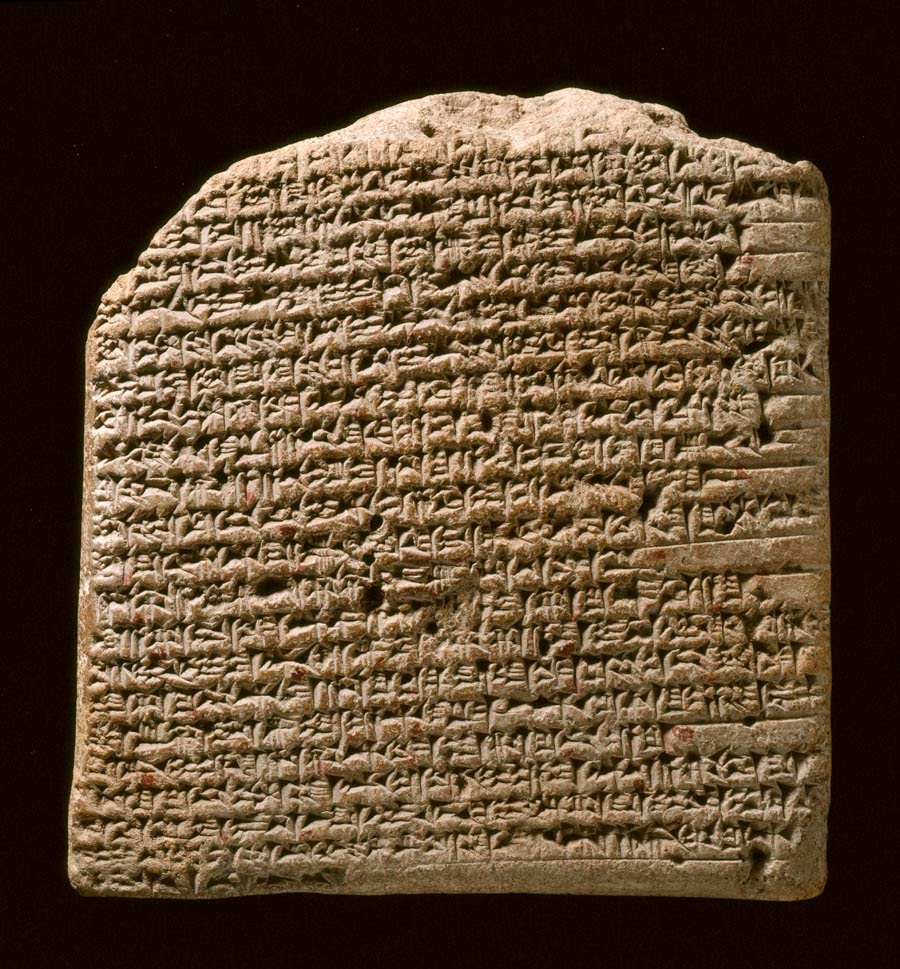
What if I told you this was an ancient version of the modern tablets we have today, like the iPad? You can kinda see it...It's handheld, you can write on it, bring it with you...it's more convenient than writing in the sand. It saves your document...But it's quite a stretch. What if I told you that the original maker of this ancient tablet knew all about modern tablets and their capabilities in the great complexity yet didn't have the precise words or concepts to articulate the vision he had of this amazing device. What if I said that despite the limitations of time, culture, language, and geography the maker embedded the concepts and details to the best of their ability for us to decipher in the future. You say that is ridiculous! I agree. This, in some sense, is concordism in action.

When interpreting the Bible there are several approaches one can take and it is not obvious which one to use. In fact, this is why there are different interpretations of texts by Christians. Depending on the assumptions you have going in you will come out with a different result because you are trying to find a different answer. Most of the time as an interpreter you do your best to put all of your own assumptions aside and let the text speak for itself. However, knowing the context of the writing is required to understand a text as well. It can be a tricky balance. An example is the book of Revelation. Should we take everything literally as dragons and rivers of blood, four horsemen, a woman swallowing the moon, and two beasts with crazy heads and horns, etc? I think not! I see this and know that it is apocalyptic imagery that it is symbolic and trying to communicate a message through a particular medium.

When we come to the early texts of Genesis I feel much the same way, and as with Revelation, I feel I still have much to learn and understand. However, There is a choice we need make that affects our interpretation. Does Genesis teach us science? I hold loosely to a sort of literary framework hypothesis approach to interpreting Genesis 1. I do not think Genesis is teaching us that the earth is young, but I also do not think that Genesis is teaching us that the earth is old! I do not hold to a strict harmonizing of the Genesis account and modern science. There are points where one has to ask questions about these issues theologically, but interpretively I see no assertions in the text itself one way or the other that require a particular position on the age of the earth or universe.

Those who hold that Genesis teaches the age of the earth fall into two categories; Young Earth or Old Earth. Both of these are concordist in their approach. Much of the debate surrounds Young Earth Creationists condemning the compromising old earth peeps and fighting the Naturalists/Atheists to no avail. I am a non-concordist, though I do think the earth and universe are old for scientific reasons. For an article outlining the strengths and weaknesses of both approaches, check out this article from BioLogos.org which includes the diagram shown below:

Concordist Interpretations: Non-concordist Interpretations:
Young Earth Interpretation
Creation occurred about 6,000 years ago, during six 24-hour days, in the order described. A scientific study of the earth should confirm this.
Proclamation Day Interpretation
The days of Genesis 1 took place in God’s throne room, wherein God proclaimed each step of creation. The throne-room days are not related to days or time periods on earth.
Gap Interpretation
Earth was created long ago (Gen 1:1), became “formless and empty” (Gen 1:2), and was restored about 6,000 years ago during six 24-hour days.
Creation Poem Interpretation
The number and ordering of the “days” of Genesis 1 are chosen for poetic and thematic reasons rather than historical reasons.
Day-Age Interpretation
Creation occurred over billions of years. Each “day” of Genesis 1 corresponds to a long epoch. Events occurred in the order given in the text, but stretched out over a longer time period.
Kingdom and Temple Interpretations
As the great King, God gives humans dominion as in a “land grant” covenant. Alternatively, God inaugurates the cosmos as his temple. In both cases, the text is not focused on the physical universe.
Appearance of Age Interpretation
Creation occurred about 6,000 years ago during six 24-hour days, but it was created to look like it had a long history of billions of years.
Ancient Near Eastern Cosmology Interpretation
Genesis 1 matches the physical picture of the world believed in Ancient Near East religions, but presents a dramatically different theological picture, proclaiming one God as creator of all rather than many gods.

Here are some other links of interest:
Report by the Presbyterian Creation Study Committee
Catholic view
Greek Orthodox view